
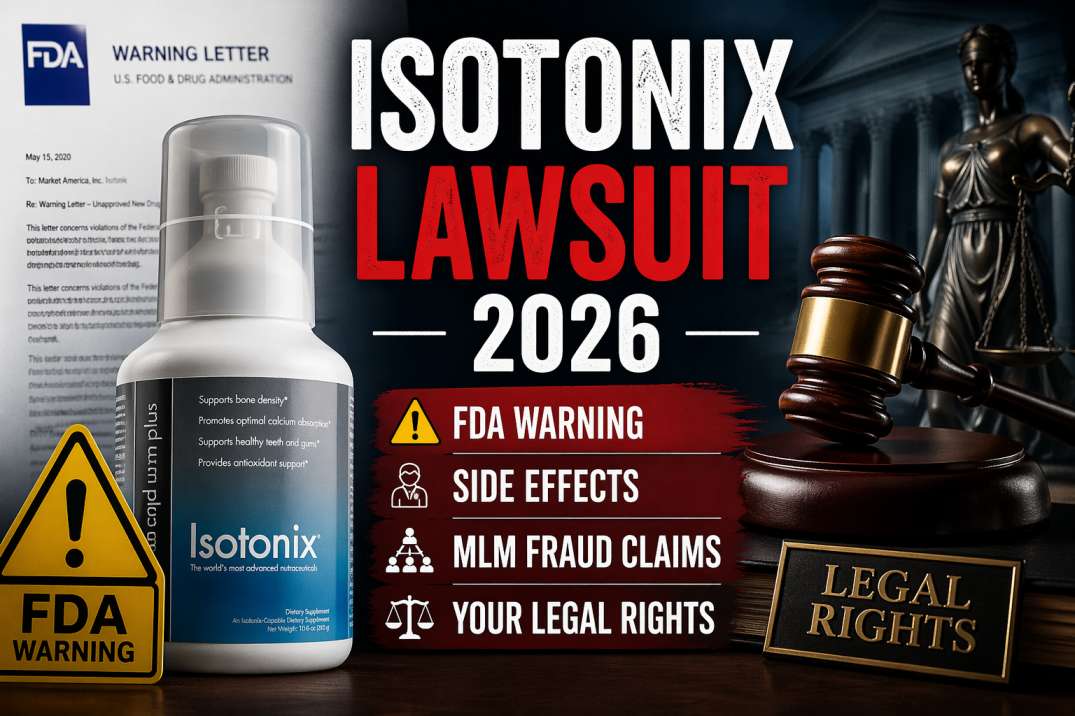
If you’ve been seeing “Isotonix lawsuit” pop up everywhere and wondering what the big deal is — you’re in the right place.
Here’s the short version: Isotonix is a line of dietary supplements sold by a company called Market America. For years, they told people their products were absorbed “up to 90% faster” than regular vitamins, could help with heart disease, diabetes, arthritis — maybe even cancer. They also told thousands of people they could build a life-changing business by selling these products.
The lawsuits — and there are multiple — argue that most of these claims were either exaggerated, unproven, or outright false. Real people lost real money. Some experienced real health problems. And now, the courts are getting involved.
⚠️ Important: As of 2026, no formal settlement has been reached. The case is still active in federal court. If you were affected, your window to file a claim may be time-sensitive.
This case shares similarities with other legal disputes, such as the Texas construction lawsuit and USAA SafePilot patent lawsuit, where multiple claims and financial damages are involved. Franchise-related misrepresentation cases follow a similar pattern, as documented in the Blinglelawsuit, where investors alleged they were shown inflated revenue figures before buying into the franchise system.
Consumer trust lawsuits are becoming more common in multiple industries, including the ongoing Life360 lawsuit, where users allege their private location data was sold without proper consent.
Table of Contents
What Is the Isotonix Lawsuit?
The Isotonix lawsuit is not one single court case — it’s a combination of consumer complaints, regulatory actions, and legal filings all pointing at the same company: Market America, the parent company behind the Isotonix supplement line.
At its core, the lawsuit questions three things:
1. Were the health claims real?
Isotonix products were marketed as being able to prevent serious diseases — without FDA approval.
2. Was the science legit?
The “90% faster absorption” claim that drove millions in sales? Plaintiffs say there’s no solid clinical evidence behind it.
3. Was the business opportunity honest?
Thousands of people invested serious money to become distributors. Most never saw the returns they were promised.
This case matters beyond just one brand. It shines a spotlight on how the entire $50 billion supplement industry often operates in a legal gray zone — and what happens when regulators and consumers finally say enough.
Who Is Market America & What Is Isotonix?
To understand the Isotonix Lawsuit, you need to understand the company behind it.
Market America was founded in 1992 in Greensboro, North Carolina. It operates as a multi-level marketing (MLM) company. Instead of selling products in stores, they recruit everyday people to become “UnFranchise Business Owners” — or UFOs — who sell products directly and earn money from both sales and recruiting new members.
Isotonix was introduced in 2004. The name comes from “isotonic” — a formula that supposedly matches the body’s natural fluid pressure, allowing nutrients to absorb faster than standard pills.
The Isotonix Product Line Includes:
- Isotonix OPC-3 — A concentrated antioxidant blend with pine bark, red wine extract, bilberry, and citrus extracts
- Isotonix Multivitamin — Daily vitamin formula
- Isotonix Heart Health — Marketed for cardiovascular support
- Isotonix Immune — Promoted during the COVID-19 era as immune support
- Targeted formulas — For joints, digestion, weight management, and athletic performance
The pitch was compelling: why swallow a pill when a powder-drink could deliver nutrients directly to your bloodstream faster? It resonated. Sales grew. The distributor network expanded. And then the questions started.
Complete Timeline: From Launch to Lawsuit (2004–2026)
2004 — Isotonix Launches
Market America introduces the Isotonix line with bold isotonic absorption claims. Products quickly gain popularity through the MLM network.
2010–2015 — Complaints Begin Rising
Consumer complaints start surfacing. Reports of products not delivering promised results. Distributors begin sharing stories of financial losses despite significant upfront investment.
2017 — First Major Isotonix Lawsuit Filed
Two former distributors — Chuanjie Yang and Ollie Lan — file a federal lawsuit in California, claiming Market America operates an illegal pyramid scheme. That same year, TINA.org (Truth in Advertising) launches an investigation into deceptive income claims. The Isotonix Lawsuit is moved to private arbitration.
May 2019 — FDA Inspection
The FDA inspects Market America’s Greensboro facility. Investigators document multiple labeling violations and a failure to report serious adverse health events.
February 2020 — FDA Issues Warning Letter
This is the big one. The FDA formally warns Market America about illegal drug-like claims, product mislabeling, and failing to report a customer hospitalization. Multiple Isotonix products are named.
2020–2021 — FTC Warnings
The FTC warns Isotonix distributors about making unsubstantiated COVID-19 immunity claims. Class action complaints begin consolidating in federal court.
2025 — Class Action Grows
Over 400 plaintiffs join the proposed class action. A federal judge allows false advertising claims to proceed, ruling that phrases like “clinically proven” in marketing materials could mislead reasonable consumers.
2026 — Case Still Active
Pre-trial proceedings continue. Both sides are exchanging evidence, including internal company emails about safety complaints. No settlement announced. Legal analysts predict settlement talks may begin mid-2026.
Key Allegations — Explained in Plain Language
Allegation #1: The “90% Faster Absorption” Claim Was Misleading
This was Isotonix’s biggest selling point. The idea that their isotonic formula delivers nutrients up to 90% faster than pills. It sounds scientific. It sounds impressive. It sounds like something you’d pay a premium for.
But here’s the problem — plaintiffs and independent researchers found no peer-reviewed clinical studies that specifically validate this 90% figure for Isotonix products. The claim appears to have been borrowed from general concepts about isotonic solutions, not from controlled trials on these specific supplements.
Consumers paid premium prices based on this claim. Many chose Isotonix over cheaper alternatives specifically because of it. The lawsuit argues this is false advertising under the FTC Act.
Allegation #2: Disease Treatment Claims Without FDA Approval
Dietary supplements have one strict rule: they cannot legally claim to treat, cure, or prevent diseases. That’s the territory of FDA-approved drugs.
Yet marketing materials promoted Isotonix as effective against:
- Heart disease and high blood pressure
- Type 2 diabetes and blood sugar regulation
- Arthritis and chronic inflammation
- Cancer (through antioxidant claims)
- COVID-19 prevention
None of these claims were FDA-approved. The 2020 Warning Letter called this out directly.
Allegation #3: Deceptive Income Promises to Distributors
Thousands of people signed up as distributors after being shown income projections that painted a picture of financial freedom. The reality was different. Former distributors report investing thousands of dollars in inventory, training materials, and event fees — only to find that making real money was far harder than advertised.
Critics point out that, like most MLMs, the vast majority of distributors earn little to nothing after expenses.
Allegation #4: Labeling Violations
This sounds minor, but it isn’t. The FDA found that serving size information on products like Isotonix OPC-3 was inconsistent — the label said one amount, the instructions said another. When you’re dealing with high-potency supplements, inaccurate dosing information can lead to either underdosing (wasting money) or overdosing (potential health risks).
The FDA Warning Letter: What It Actually Said
The FDA Warning Letter was issued on February 14, 2020 to Market America’s CEO. It followed an official facility inspection and is publicly available on the FDA website. Here’s what it found:
Violation #1 — Illegal Drug Claims: Marketing language crossed the legal line from supplement claims into drug claims. Saying a product can “lower cholesterol,” “treat arthritis,” or “prevent heart disease” legally classifies it as a drug — requiring clinical trials and FDA approval that Market America never obtained.
Violation #2 — Misbranding: Labels on multiple products contained incorrect serving size information. In one notable example, OPC-3 instructions directed users to take two capfuls, but the Supplement Facts panel was calculated for only one capful — meaning consumers had no idea of the actual nutrient amounts they were consuming.
Violation #3 — Failure to Report Adverse Events: This is arguably the most serious finding. A consumer was hospitalized after using a TLS 21-Day Challenge Kit containing Isotonix OPC-3. Federal law requires manufacturers to report serious adverse events to the FDA within 15 business days. Market America did not report this hospitalization.
Products specifically named in the Warning Letter: Isotonix OPC-3, Isotonix Multivitamin, Isotonix Multivitamin with Iron, Isotonix Activated B-Complex, Heart Health Essential Omega III Fish Oil, and TLS 21-Day Challenge Kit.
Reported Side Effects
It’s important to be clear: no direct causal relationship between Isotonix products and the following side effects has been legally proven in court. These are symptoms most frequently cited in plaintiff reports and consumer complaints currently under investigation.
Cardiovascular Issues
Irregular heartbeat, elevated blood pressure, and chest discomfort reported by multiple plaintiffs — potentially linked to high-dose antioxidant formulations.
Neurological Symptoms
Persistent migraines, vertigo, tremors, and dizziness — reported especially in connection with OPC-3 and other high-potency blends.
Liver Concerns
Elevated liver enzymes and hepatitis-like symptoms have been reported. Medical experts note that excessive antioxidant intake can paradoxically stress the liver rather than protect it.
Gastrointestinal Distress
Nausea, stomach pain, bloating, and in some severe cases, ulcer-like symptoms mentioned in consumer complaints.
Antioxidant Overdose Risk
OPC-3 contains resveratrol and Vitamin B12 at levels exceeding 5,000% of the daily recommended value per serving. Research suggests mega-dosing antioxidants can actually cause cellular damage rather than prevent it.
Fatigue & Sleep Disruption
Some users reported unexpected fatigue and disrupted sleep — the exact opposite of the promised energy and wellness benefits.
⚠️ If you’ve experienced any of these symptoms after taking Isotonix products, consult a doctor immediately and document the connection. This documentation will be critical if you decide to pursue legal action.
The Pyramid Scheme Problem: MLM vs. Illegal Scheme
This is one of the trickiest parts of the case to understand, so let’s break it down clearly.
Multi-level marketing is legal. Selling products and earning commissions — that’s a legitimate business. The problem arises when the money in the system comes primarily from recruitment rather than actual product sales to real consumers.
Legal MLM: Revenue comes from genuine product sales to end consumers. Most distributors can realistically profit. Income disclosures are transparent.
Pyramid Scheme: Revenue depends mainly on recruiting new members. Only those at the top profit significantly. Distributors are required to buy inventory just to stay active.
What Plaintiffs Allege About Market America: The 2017 lawsuit argued that distributors were required to purchase products primarily to maintain their “UFO” status — not because there was genuine consumer demand. If true, the money circulating in the system was coming from new recruits buying in, not from outside consumers wanting the products. That structure is what legally defines a pyramid scheme.
The case was moved to private arbitration, so no public ruling exists. But the FTC has been watching.
Isotonix vs. Other MLM Supplement Lawsuits
The Isotonix case doesn’t exist in a vacuum. Here’s how it compares to other major MLM supplement cases:
Herbalife (2016) Allegations: Pyramid scheme, false income claims Outcome: FTC settlement, company restructuring required Fine: $200 million
AdvoCare (2019) Allegations: Pyramid scheme, false advertising Outcome: FTC settlement, completely abandoned MLM model Fine: $150 million
Hydroxycut (Class Action) Allegations: False weight loss claims, health harm Outcome: Class action settlement Consumer Fund: $40 million
Market America / Isotonix (2026) Allegations: False health claims, pyramid scheme, FDA violations Status: Ongoing — no settlement yet
The pattern is clear. When regulators and courts act on cases like this, the outcomes can be significant. Herbalife paid $200 million. AdvoCare had to abandon its entire MLM model. The Isotonix case is still building.
Current Isotonix Lawsuit Status in 2026
Here’s exactly where things stand as of April 2026:
- Discovery phase is active — Both sides are exchanging evidence. Internal Market America emails about safety complaints are reportedly central to the case.
- No settlement announced — Market America continues to deny wrongdoing.
- Key ruling already favored plaintiffs — A federal judge allowed false advertising claims to proceed, ruling that phrases like “clinically proven” in marketing could mislead an average consumer.
- 400+ plaintiffs have joined the proposed class action after reporting similar injuries and financial losses.
- Legal analysts predict settlement talks may begin in mid-to-late 2026, potentially before the case goes to full trial.
One important nuance: some legal sources note that there is no single federal court case titled specifically “Isotonix Lawsuit.” The term is an umbrella used to describe the FDA regulatory action, the 2017 distributor lawsuit (sent to arbitration), and the newer proposed consumer class action — all happening simultaneously.
Your Legal Rights: What To Do If You Were Affected
If you purchased Isotonix products, experienced side effects, or lost significant money as a distributor, here’s what to do — step by step.
Step 1: Document Everything Immediately
Gather receipts, order confirmations, supplement bottles, and packaging. If you experienced health issues, collect medical records, doctor’s notes, and lab results. If you were a distributor, save enrollment documents, income statements, and all training materials.
Step 2: Report to the FDA via MedWatch
File an official report at fda.gov/safety/medwatch. This creates an official record and contributes to the ongoing regulatory case. Even minor side effects are worth reporting — patterns matter in these investigations.
Step 3: File a Complaint with the FTC
If you were misled about income potential as a distributor, file a complaint at reportfraud.ftc.gov. The FTC uses consumer complaints to build cases against MLM companies.
Step 4: Consult a Consumer Protection Attorney
Look for attorneys who specifically handle dietary supplement lawsuits or MLM fraud cases. Ask: “Have you handled supplement or MLM false advertising cases?” and “Do you work on contingency?” Top national firms like Morgan & Morgan handle these cases with no upfront fees — you only pay if you win.
Step 5: Monitor Class Action Status
Check ClassAction.org regularly for updates on the Market America / Isotonix case. If a class is certified and a settlement is reached, you may be eligible to participate without filing separately. But deadlines apply — don’t wait.
💡 Good to know: Even without physical product bottles, your bank statements, credit card records, or distributor purchase history can serve as proof of purchase for a potential claim.
Frequently Asked Questions
Is Isotonix FDA approved?
No. Dietary supplements like Isotonix are not FDA-approved before reaching the market. However, companies are prohibited from making disease-treatment claims without approval — which is exactly what the 2020 Warning Letter cited.
Is there an active class action lawsuit against Isotonix right now?
There is a proposed class action in federal court with 400+ plaintiffs as of 2026. It has not yet been formally certified as a class, but pre-trial proceedings are active.
Can I still use Isotonix products while the lawsuit is ongoing?
Isotonix products have not been recalled and remain on sale. No causal link to health harm has been proven in court yet. If you have concerns, consult your doctor before continuing use — especially if you take other medications.
How much compensation could I receive?
This depends on the nature and severity of your claim. For comparison, past supplement class action settlements (like Hydroxycut) ranged from $5,000 to $200,000 per claimant depending on injury severity. No Isotonix settlement has been announced yet.
Is Market America a pyramid scheme?
This has not been proven in court. The 2017 lawsuit raised these concerns but was moved to private arbitration. The FTC has issued warnings but has not formally classified Market America as an illegal pyramid scheme as of 2026.
What is Isotonix OPC-3 and why is it specifically mentioned?
OPC-3 is Isotonix’s flagship antioxidant supplement. It’s specifically cited in lawsuits because: (1) it was named in the FDA Warning Letter for illegal disease claims, and (2) a consumer was hospitalized after using a kit containing OPC-3 — which Market America failed to report to the FDA as required by law.
What happened to the original 2017 lawsuit?
The Yang v. Market America case was moved from open federal court to private arbitration. This means proceedings are confidential and no public outcome has been announced. This is common in MLM lawsuits, as many companies include mandatory arbitration clauses in their distributor agreements.
Final Verdict
The Isotonix lawsuit is a legitimate and serious legal matter — not just internet noise.
Between the documented FDA Warning Letter, a growing plaintiff pool of 400+ people, active federal court proceedings, and a regulatory pattern that mirrors past MLM crackdowns on Herbalife and AdvoCare — there are real questions here that deserve real answers.
Whether you’re a former customer who didn’t get the health results promised, a distributor who lost money chasing a business dream, or someone who experienced unexpected health symptoms — your experience matters and your legal options are real.
The broader lesson from the Isotonix Lawsuit case is one the entire supplement industry needs to hear: bold marketing without solid science doesn’t just mislead consumers — it eventually catches up with companies in court. In 2026, with more consumers educated about their rights and more attorneys specializing in supplement fraud, the era of consequence-free health claims may finally be ending.
If you’re exploring similar financial and legal controversies, you can also read our detailed breakdown of the Edward Jones Kingsview Advisors lawsuit and Snow teeth whitening lawsuit
Stay informed. Document your experience. And if you’ve been affected — don’t wait.
Disclaimer: This article is for informational purposes only and does not constitute legal advice. Information is based on publicly available court filings, FDA records, and verified news sources as of April 2026. Consult a licensed attorney for advice specific to your situation.