
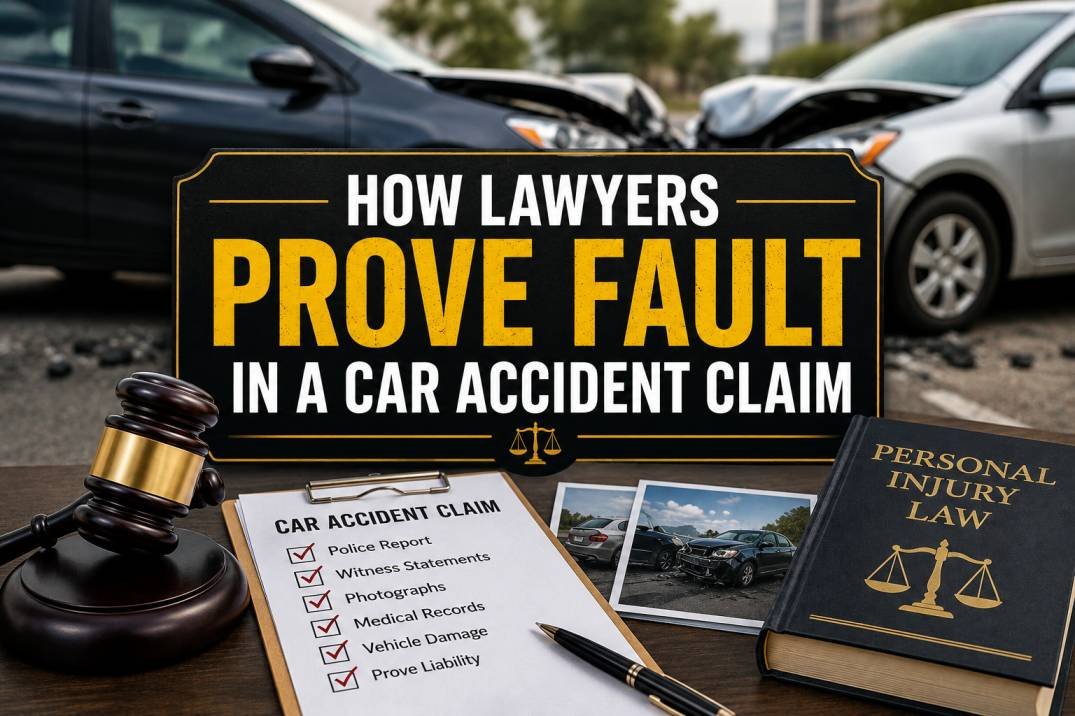
Insurance companies usually start looking into a car crash quickly like within a few hours. They do this because they want to find ways to pay out money or not pay out at all. If you are a driver who got hurt you need to do more than just show that your car is damaged or say that you are in pain after the crash. You need to prove that the other person was at fault.
Insurance companies and lawyers can be pretty tough when it comes to paying out money. So it is an idea for people who were in a car crash to know how lawyers figure out who was, at fault. This can help people who were hurt in the crash protect their right to get money from the insurance company. It is especially important to do this before evidence like pictures of the crash or witness statements gets lost or forgotten. If this happens it can be harder to prove what really happened. The insurance company might try to say that the crash happened in a different way.
In Little Rock, Arkansas, heavy commuter traffic, highway congestion, and fast-moving insurance investigations can make liability disputes especially stressful after a serious wreck. Many people turn to a car accident lawyer in Little Rock because strong claims are built on evidence, timelines, witness statements, and early-gathered medical documentation.
The insurance company might try to say that the crash happened in a different way. Understanding common car insurance disputes can help strengthen a claim.
Truck accidents involve additional legal issues because federal trucking regulations often play a major role in determining liability.
Starting With Fault
Liability in a car accident claim rests on four core elements: duty of care, breach, causation, and damages. Every driver owes others reasonable care on public roads. Counsel must show that duty was breached through distraction, speeding, intoxication, fatigue, or another unsafe maneuver. Facts alone are not enough. Insurers usually challenge the connection between conduct and injury, so each piece of evidence must support the same account without any gaps.
Early Evidence Matters
Time changes a crash scene very quickly, which is why a car accident lawyer often starts by preserving evidence that may disappear first. Tire marks fade, surveillance footage gets overwritten, and witness memory becomes less reliable within days. Police paperwork helps, but it rarely resolves every dispute. Lawyers gather photographs, measurements, vehicle data, witness contact details, and phone records before missing material weakens the claim.
Police Reports Help Build the Case
An officer’s report can provide details on road conditions, diagrams, citations, and immediate observations from the scene. Those details gain force when they align with photographs and vehicle damage. Insurers still may resist the report’s conclusion. Some argue the officer arrived after the impact and relied on partial accounts. Lawyers treat that document as useful support while closely reviewing it for omissions, mistaken directions, or imprecise language.
Witnesses Help Fill Gaps
Statements made by independent witnesses carry real weight because they usually have no vested interest in the outcome. Their accounts may confirm a signal violation, sudden lane drift, or a late braking attempt. Lawyers try to secure statements quickly, while memory remains stable. Small changes matter. Insurers often magnify minor differences to call reliability into question, even when the central account remains consistent from the first interview onward.
Vehicle Damage Tells a Story
Vehicle damage often reveals the angle of impact, sequence of events, and relative force involved in the crash. Crush depth, paint transfer, shattered glass, airbag deployment, and wheel position may support or contradict what drivers later say. Lawyers use inspection photographs, repair records, and electronic vehicle data when available. That material becomes valuable when an insurer claims the impact was too minor to injure anyone. Physical evidence can expose a mismatch between denial and mechanics.
Medical Records Connect the Injury to the Crash
A liability claim weakens when the injury appears disconnected from the crash. For that reason, lawyers build a clear timeline using emergency notes, imaging, follow-up visits, therapy records, and physician opinions. Delayed care often raises insurers’ doubts. Consistent documentation helps show symptoms began after the collision rather than before it. That sequence supports causation, which often becomes the key point of dispute once fault is harder to deny.
Traffic Laws Support Liability Arguments
Road rules and traffic laws often give the liability argument a clear structure. Running a stop sign, following other vehicles too closely, or failing to yield can establish a breach of duty directly. Lawyers compare witness accounts with roadway markings, traffic control devices, and applicable local statutes. Shared fault arguments remain a common insurer defense. Counsel may then evaluate whether the injured person had any realistic chance to avoid the collision after the other driver acted carelessly.
Experts Clarify Complex Disputes
Some cases require expert analysis because the facts remain contested even after basic evidence has been collected. Reconstruction specialists examine speed, sight lines, stopping distance, and vehicle movement. Medical experts assess whether the claimed injuries align with the crash mechanics and treatment course. Their opinions can weaken insurer theories built on speculation. Technical input does not replace strong groundwork. It helps explain complicated facts in a clear, credible way.
Insurers Examine Every Detail
Insurance companies review inconsistencies, prior injuries, delayed treatment, social media posts, and recorded statements to identify weaknesses. Lawyers prepare for that scrutiny by checking chronology, wording, and supporting documents before settlement talks deepen. One loose detail can affect the value of the claim. Presentation matters as well. When records, testimony, and physical evidence align cleanly, insurers face greater pressure to accept responsibility rather than continue to deny.
Conclusion
Proving driver liability rarely depends on one dramatic fact. Strong car accident cases are built through disciplined collection of witness accounts, scene evidence, medical records, vehicle damage analysis, and applicable traffic rules. Lawyers use that framework to respond to insurer objections one issue at a time. When each part of the evidence supports the next, the claim becomes far more difficult to discount. That method gives injured people a stronger path through negotiations and, when necessary, a trial.
Disclaimer: This article is for informational purposes only and does not constitute legal advice. Laws vary by jurisdiction, and readers should consult a qualified attorney regarding their specific situation. Reserved Powers is not a law firm and does not provide legal services.