If you use USAA’s SafePilot app to save money on your car insurance, you may have heard about a growing legal battle surrounding it. The USAA SafePilot patent lawsuit has quietly become one of the most consequential intellectual property disputes — similar to other major cases like the isotonix lawsuit
— and it directly affects millions of drivers who rely on the app every day.
In this guide, we break down everything: what SafePilot actually does, who is suing USAA and why, what the legal arguments are, what could happen to your app and discounts, and what this case means for the future of usage-based insurance in America.
Table of Contents
What Is USAA SafePilot?
SafePilot is a telematics-based mobile app offered by USAA (United Services Automobile Association) — one of America’s most trusted insurance providers, primarily serving military members, veterans, and their families.
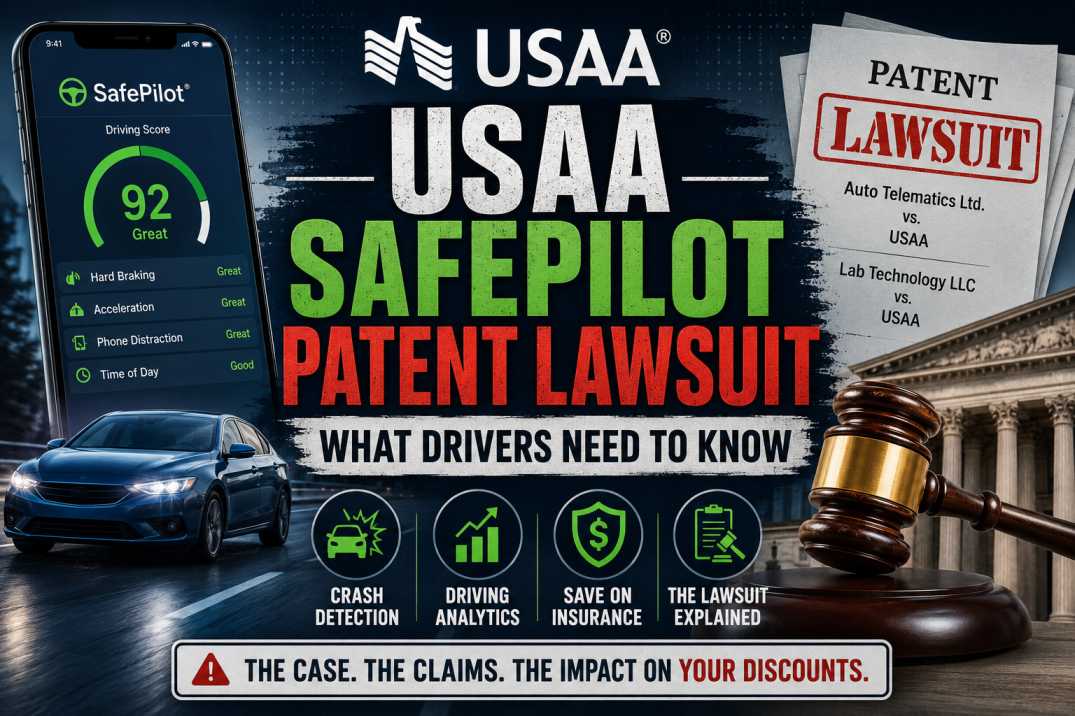
Once you download SafePilot and give it permissions, it runs quietly in the background whenever you drive. It tracks:
- Speed and acceleration patterns
- Hard braking incidents
- Phone distraction behavior (whether you’re using your phone while driving)
- Time of day you drive
- Automatic crash detection — perhaps its most advanced feature
That last feature is the one at the center of the legal storm. When the app’s sensors detect a sudden, violent impact, it automatically contacts emergency services, notifies your designated emergency contacts, and begins logging data for a potential insurance claim — all without you lifting a finger.
Drivers who demonstrate safe habits receive discounts on their insurance premiums. Millions of USAA members have enrolled in SafePilot, making it one of the most widely used telematics programs in the country.
The USAA SafePilot Patent Lawsuit: How It All Started
USAA SafePilot Patent Lawsuit #1: Auto Telematics Ltd. (May 2022)
The first major patent challenge came in May 2022, when Auto Telematics Ltd. — a York, England-based company (previously operating under the name Snoring Dog Ltd.) — filed suit against USAA in the U.S. District Court for the Western District of Texas.
Auto Telematics alleged that the SafePilot mobile app infringed four of its patents related to using a mobile device to:
- Log driving information associated with a vehicle
- Transmit that data to a central system
- Analyze driver behavior for risk assessment
- Adjust insurance premiums based on the collected data
According to the complaint, Auto Telematics owns patents covering “the core components” of telematics systems that many insurance companies now use to monitor driving performance and offer premium adjustments. The company argued that USAA’s SafePilot incorporated these patented methods without obtaining a proper license.
Auto Telematics is what the legal world calls a patent assertion entity — a company that develops and owns intellectual property and licenses it to others, rather than manufacturing consumer products itself. Such companies often file suits when they believe their patents are being used commercially without authorization.
Lawsuit #2: Lab Technology LLC (2024)
Then came a second blow. In 2024, another company — Lab Technology LLC — filed a separate patent infringement case against USAA in federal court.
Lab Technology’s claims were more targeted: the company says it owns patents specifically connected to mobile crash detection and automated emergency alert systems. Its complaint argues that SafePilot’s hallmark crash-detection feature uses methods covered under those patents — specifically, the smartphone-based collision detection and the automated communication sequence that follows.
This is the lawsuit that has attracted the most attention in 2025–2026 because it goes after SafePilot’s most advanced and widely praised feature.
A Clear Timeline of the Legal Battle
| Year | Event |
|---|---|
| 2017 | USAA begins filing patent lawsuits of its own against other insurers using mobile technology |
| May 2022 | Auto Telematics Ltd. files suit in W.D. Texas alleging SafePilot infringes 4 patents |
| 2023 | Case proceeds through discovery and pre-trial motions |
| 2024 | Lab Technology LLC files a second patent suit against USAA targeting the crash detection feature |
| 2025 | Both cases gain national media attention; insurance industry begins watching closely |
| 2026 | USAA reportedly seeks broader legal protection; cases remain ongoing |
Notice the remarkable reversal: USAA was once the aggressor — the company that filed patent lawsuits against competitors in the mobile technology space. Now, it finds itself on the other side of that equation.
What Are the Patents Actually About?
To understand this lawsuit, you need to understand what telematics patents typically cover. They’re not simple to evaluate because they involve highly technical claims about software and sensor interactions.
In patent lawsuits involving mobile apps, courts generally examine:
1. System Architecture — How is the overall system designed? Does the accused app use a “downloaded application” that logs vehicle data through a mobile device’s built-in sensors in the way the patent describes?
2. Data Collection Methods — How specifically does the app collect sensor data? What sensors are used, and how is the data formatted?
3. Data Transmission — How is the data sent to a central server? What protocols are used?
4. Analysis Algorithms — How is driver behavior scored? Does the algorithm match the steps described in the patent claims?
5. Crash Detection Logic — For Lab Technology’s case, the key question is whether SafePilot’s collision-detection trigger and response sequence matches the patented method step by step.
USAA has not admitted any violation. The company’s likely defenses include: arguing the patents are invalid, claiming SafePilot’s technology is structurally different from what the patents describe, and disputing any damage calculations.
Does This Lawsuit Affect USAA Members and SafePilot Users?
This is the question most drivers are asking — and the answer is nuanced.
Your coverage is NOT at risk.
A patent lawsuit is purely an intellectual property dispute between companies. It does not invalidate your insurance policy, cancel your coverage, or affect your existing claims. Insurance regulators and patent courts operate in completely separate systems.
Your discounts are likely safe — for now.
SafePilot discounts continue under existing terms while the litigation is pending. Courts don’t typically issue injunctions (orders to stop using a technology) unless there is clear, overwhelming evidence of infringement and immediate harm.
Some features of USAA SafePilot Patent Lawsuit could change in the future.
If Lab Technology or Auto Telematics ultimately wins and a court rules that specific SafePilot features infringe their patents, USAA would face a few options: pay licensing fees and continue operating, redesign the affected features, or appeal. In practice, settlements are extremely common in patent disputes of this type — the more likely outcome is a licensing agreement behind closed doors, with SafePilot continuing to function as normal.
Users may notice app updates.
If USAA chooses to proactively modify any feature in response to legal pressure (a common strategy called “designing around” a patent), users could see software updates. These would likely be seamless in practice.
Why the Western District of Texas?
If you’re wondering why a British company (Auto Telematics) and a U.S. patent holder are both filing suits in Waco, Texas, you’re not alone. The Western District of Texas — particularly the Waco Division — has become one of the most popular venues for patent litigation in America because of its historically fast trial schedules and plaintiff-friendly track record. Patent holders often strategically choose this court to put pressure on defendants to settle quickly.
The Bigger Picture: What This Means for the Insurance Industry
The USAA SafePilot patent lawsuit isn’t just about one company. It’s a signal flare for the entire usage-based insurance (UBI) sector.
Programs like Progressive Snapshot, Allstate Drivewise, State Farm Drive Safe & Save, and Liberty Mutual RightTrack all operate on the same basic technological principles as SafePilot. They all use mobile apps, smartphone sensors, driving analytics, and automated features to price insurance and engage customers.
If courts begin ruling that the foundational components of telematics apps infringe existing patents, every one of these companies faces the same exposure. The downstream effects for consumers could include:
- Fewer smart features in insurance apps
- Reduced or eliminated safe-driver discounts
- Higher premiums to offset licensing costs
- A slowdown in innovation as insurers become more cautious
Beyond insurance, this case also reignites the broader debate about software patent quality in America. Critics argue that overly broad software patents stifle innovation rather than protect it. Proponents argue they are essential for small inventors to monetize genuine technical breakthroughs without being steamrolled by corporate giants.
What Could Happen Next? Possible Outcomes for USAA SafePilot Patent Lawsuit
Patent cases rarely end with a dramatic courtroom verdict. Here’s a realistic look at where this goes:
1. Settlement with Licensing Agreement (Most Likely) USAA and the patent holders reach a private financial agreement. USAA pays royalties in exchange for a license. SafePilot continues unchanged. This resolves the vast majority of high-profile patent suits.
2. USAA Wins at Trial The court rules that SafePilot’s technology doesn’t infringe the asserted patents — either because the patents are invalid, or because SafePilot works differently enough to fall outside their scope.
3. Patent Holder Wins Damages The court awards financial damages to Auto Telematics and/or Lab Technology. USAA pays but continues operating. App features may be updated to reduce future exposure.
4. Injunction (Very Unlikely) The most dramatic outcome — a court orders USAA to stop using certain features until a license is obtained. Courts grant injunctions sparingly and only under specific legal standards. This outcome is theoretically possible but practically rare for established commercial apps serving millions of users.
Key Legal Terms for USAA SafePilot Patent Lawsuit Explained Simply
Patent Infringement — Using a patented invention without the patent owner’s permission.
Telematics — Technology that combines telecommunications and informatics to collect and transmit data from vehicles or mobile devices.
Usage-Based Insurance (UBI) — An insurance model where premiums are based on actual driving behavior rather than demographic factors alone.
Patent Assertion Entity (PAE) — A company that owns patents primarily to license them or sue infringers, rather than to build products.
Injunction — A court order requiring a party to stop a specific action.
Damages — Financial compensation awarded by a court for proven harm.
Licensing Agreement — A contract allowing one party to use another’s patented technology in exchange for payment.
Frequently Asked Questions (FAQ) for USAA SafePilot Patent Lawsuit
Will USAA cancel SafePilot because of this lawsuit?
Almost certainly not. Patent litigation rarely results in the complete shutdown of a major commercial product. USAA will most likely settle, redesign specific features, or obtain a license.
Do I need to do anything as a SafePilot user?
No. Your enrollment, discounts, and coverage are not affected by this patent case. Continue using the app as normal and check USAA’s official communications for any updates.
Is USAA guilty of stealing technology?
No conclusion of guilt has been reached by any court. These are allegations. USAA disputes the claims. Until a final court judgment is issued, nothing has been proven.
Who is Auto Telematics Ltd.?
It is a York, England-based company formerly known as Snoring Dog Ltd. It develops and holds intellectual property related to vehicle monitoring through mobile devices.
Who is Lab Technology LLC?
Lab Technology is a U.S.-based company that claims to own patents related to mobile crash detection and automated emergency alert systems.
Why is this case filed in Texas?
The Western District of Texas, particularly Waco, has become a preferred venue for patent plaintiffs due to favorable procedural rules and historically fast trial timelines.
Could my insurance premium go up because of this?
Not directly or immediately. If USAA ultimately faces significant licensing costs, it could theoretically factor that into pricing over time — but that is speculative and far-off.
How long will this case take?
Patent cases routinely take 2–5 years to reach final resolution, especially if appeals are involved.
Final Takeaway
The USAA SafePilot patent lawsuit is a fascinating collision of innovation, law, and commerce. What started as a telematics patent claim by a small British company has grown into a multi-front legal battle that the entire insurance industry is watching.
Similar to emerging tech-related legal battles, the USAA SafePilot patent lawsuit highlights how companies face intellectual property risks in modern industries.
For SafePilot users, the day-to-day impact is minimal right now. Your coverage is safe, your discounts remain intact, and the app continues to work. But the case’s outcome — whether through settlement, trial, or redesign — will shape how insurance companies build technology products for years to come.
As always, ReservedPowers.com will continue tracking this case as it develops. Bookmark this page for updates.
Disclaimer: This article on USAA SafePilot Patent Lawsuit is for informational purposes only and does not constitute legal advice. No attorney-client relationship is formed by reading this content. For legal advice specific to your situation, consult a licensed attorney.