
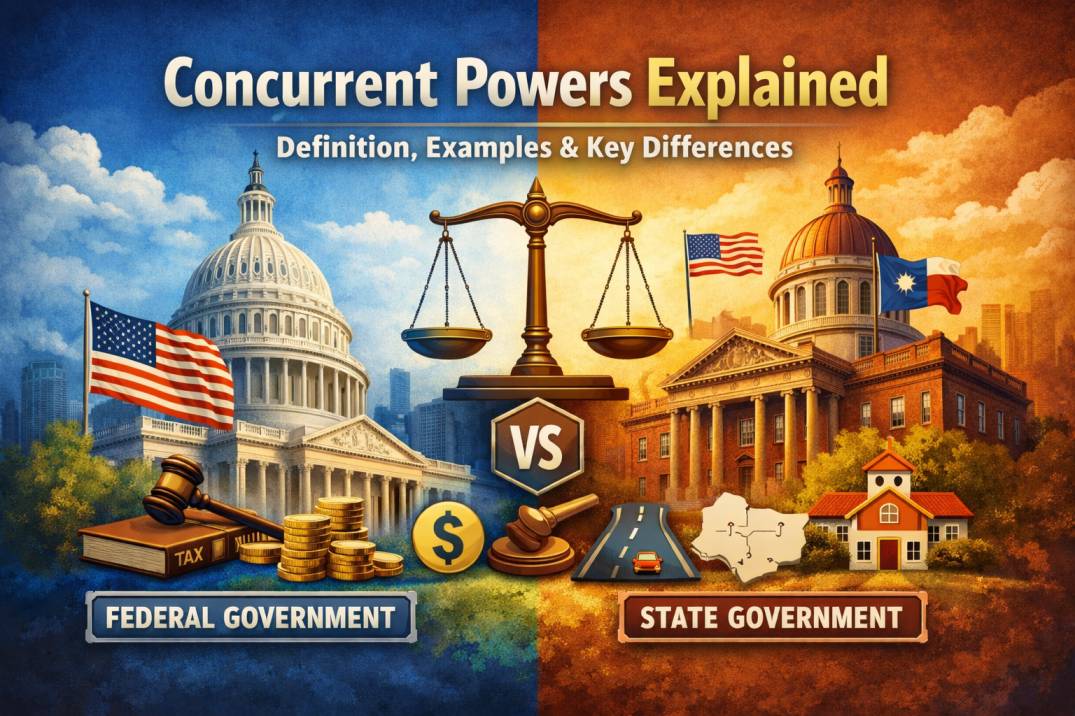
Every time you file both a federal and a state tax return, you are experiencing concurrent powers firsthand. Every time a drug dealer is prosecuted in both federal and state court for the same act, that is concurrent jurisdiction. Every time OSHA sets a workplace safety rule and your state adds its own stricter version on top — concurrent powers again.
Most Americans encounter this concept daily without ever knowing its name. This guide changes that. By the end, you will understand exactly what concurrent powers are, where they come from in the Constitution, how they actually function in real American law, and why they are so central to how the United States governs itself.
Table of Contents
What Are Concurrent Powers?
Concurrent powers are governmental authorities that both the federal government and state governments hold and can exercise at the same time. Neither level of government owns these powers exclusively. Both can act. Both can pass laws. Both sets of laws can be legally valid and enforceable simultaneously — as long as they do not directly contradict each other.
The word “concurrent” comes from the Latin concurrere — meaning “to run together.” That is exactly what happens: federal authority and state authority run together on the same subject, side by side, neither canceling the other out.
You will not find a list labeled “concurrent powers” anywhere in the Constitution. Unlike enumerated powers — which Article I, Section 8 spells out explicitly for Congress — concurrent powers are implied. They exist wherever the Constitution has not said “only the federal government may do this” and has not said “the states are forbidden from doing this.” That open space is where concurrent powers live.
The governing rule when conflict does arise: under the Supremacy Clause (Article VI, Clause 2), federal law is the supreme law of the land. When a federal law and a state law on the same concurrent subject cannot both be followed, federal law wins. But — and this is important — conflict is the exception, not the rule. Most of the time, federal and state concurrent laws coexist without anyone having to choose between them.
Where Do Concurrent Powers Come From?
To understand concurrent powers, you need to understand the broader architecture of how the Constitution divides governmental authority.
The Constitution grants enumerated powers to Congress in Article I, Section 8 — the power to coin money, declare war, regulate interstate commerce, establish post offices, and so on. These are largely exclusive to the federal government. A state cannot declare war on a foreign nation or print its own currency.
At the other end, the Tenth Amendment protects what are called reserved powers — all powers not delegated to the federal government and not prohibited to the states are reserved to the states or the people. Marriage law, intrastate commerce, how a state organizes its own government — these belong to the states because the Constitution never handed them to Washington.
Concurrent powers occupy the space in between. The Constitution permits both levels to act. No clause says “only Congress may tax” or “only states may build roads.” So both do. That shared permission is the source of concurrent power.
The Founders designed this deliberately. A rigid system that assigned every possible governmental function exclusively to one level would have been unworkable. The most important things government does — raising revenue, protecting public safety, building infrastructure, educating citizens — cannot realistically be handled by one level alone. Concurrent jurisdiction makes cooperative governance possible.
How Concurrent Powers Work in Practice
Understanding the concept is one thing. Seeing how it actually operates in American law is another. Here is the practical mechanics.
When there is no conflict, both laws simply operate. A state environmental regulation and a federal environmental regulation both apply to a factory in that state. The factory must comply with both. If the state standard is stricter than the federal floor, the state standard governs in that state — but the factory is also in compliance with federal law because it has exceeded the minimum. Both laws are valid. Neither cancels the other.
When there is a genuine conflict — when it is literally impossible to comply with both a federal law and a state law at the same time — the Supremacy Clause kicks in and federal law prevails. The state law is said to be “preempted.” The factory cannot comply with a federal rule requiring a specific chemical process and a state rule prohibiting that exact process. Federal rule wins.
When Congress has “occupied the field” — even without a direct conflict — federal preemption can still occur. If Congress has regulated a subject so comprehensively that it is clear Congress intended to be the only regulator, state laws in that space are displaced even if they do not directly contradict any specific federal provision. Immigration law is the clearest example: even a well-intentioned state immigration law tends to get preempted because Congress has occupied that field.
The vast majority of concurrent power situations never reach preemption. Federal and state governments tax, regulate, prosecute, build, and fund in parallel, and the American system absorbs all of it as a normal function of federalism.
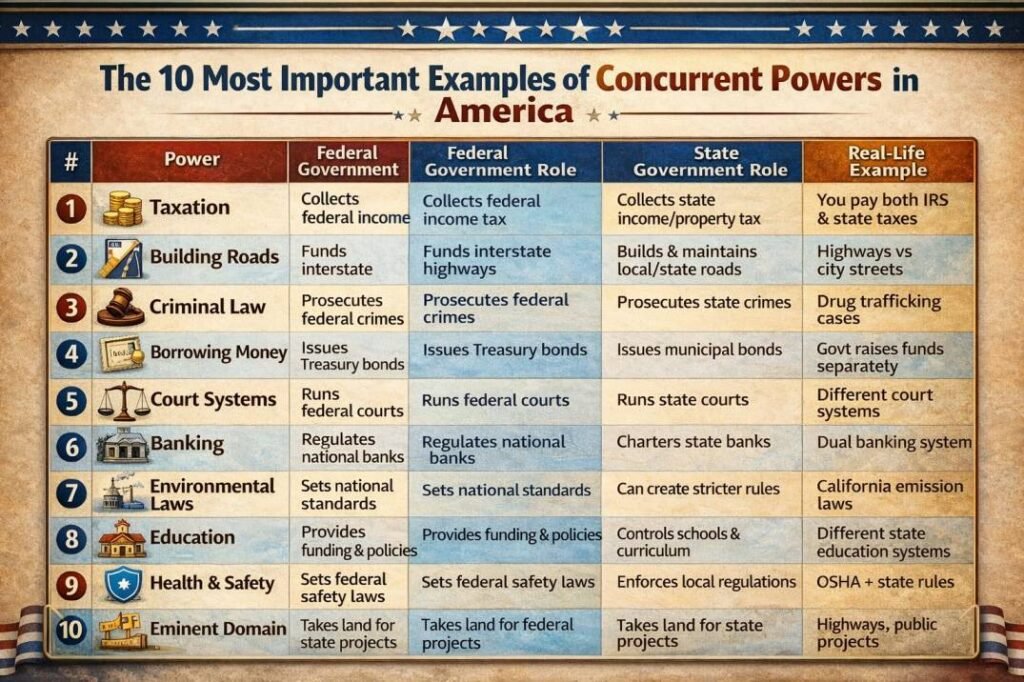
The 10 Most Important Examples of Concurrent Powers in America
1. Taxation
Taxation is the most visible concurrent power in American life. The federal government taxes income, corporate profits, capital gains, estates, and more. State governments tax income, sales, property, and business activity. County and municipal governments levy property taxes and local sales taxes. Every level exercises independent taxing authority simultaneously, and none of them needs permission from the others.
This is possible because the Constitution grants Congress the power to “lay and collect taxes” in Article I, Section 8 — but it never says states cannot also tax. States drew their taxing authority from their pre-existing sovereignty, confirmed by the Tenth Amendment. The result is the multi-layered tax system every American lives with.
The only limits: states cannot tax in ways that burden interstate commerce (the dormant Commerce Clause), and if Congress expressly preempts a state tax, the state tax falls. But absent those specific constraints, taxation is fully concurrent.
2. Criminal Law
Both the federal government and state governments define crimes and prosecute criminals. Murder, robbery, assault, and fraud can all be crimes under both federal and state law. The same physical act can violate both a federal statute and a state statute simultaneously.
This gives rise to the doctrine of dual sovereignty: because the federal government and a state are separate sovereigns, a person can be prosecuted by both for the same underlying conduct without violating the Double Jeopardy Clause of the Fifth Amendment. The Supreme Court reaffirmed this principle in Gamble v. United States (2019), ruling that a separate federal prosecution after a state conviction does not constitute double jeopardy.
In practice, federal criminal law tends to focus on crimes with an interstate or national dimension — drug trafficking across state lines, federal tax evasion, crimes on federal property — while state criminal law handles the vast majority of everyday criminal cases. But the authority overlaps, and federal prosecutors can and do bring charges in cases that state prosecutors have already handled.
3. Building and Maintaining Roads
The federal government funds and oversees the Interstate Highway System — 48,000 miles of highway built under the Federal-Aid Highway Act of 1956. States build and maintain their own highway networks, funded by state gas taxes and federal grants. Counties manage local roads. Cities handle city streets.
All three levels exercise road-building authority concurrently. A driver on a cross-country trip passes through federal interstates, state highways, county roads, and city streets — infrastructure built and maintained under concurrent governmental authority at every level.
4. Environmental Regulation
The Environmental Protection Agency sets national environmental floors — minimum standards for air quality, water quality, hazardous waste disposal, and emissions that apply across all fifty states. But states are not merely passive recipients of federal environmental policy. States can go further than federal minimums, and many do.
California is the most prominent example. The state has repeatedly obtained waivers from the EPA to set vehicle emissions standards stricter than federal law — and over a dozen other states have adopted California’s standards, creating a de facto dual regulatory system on auto emissions.
The Clean Air Act, the Clean Water Act, and RCRA all contain provisions explicitly authorizing states to run their own regulatory programs in place of federal enforcement — as long as the state program meets or exceeds the federal standard. This structure is called cooperative federalism, and it is built on concurrent jurisdiction.
5. Establishing and Operating Courts
The federal court system — 94 district courts, 13 circuit courts of appeals, and the Supreme Court — operates entirely in parallel with fifty separate state court systems, each with their own trial courts, appellate courts, and supreme courts.
Both court systems are constitutionally legitimate. Both interpret law, resolve disputes, and sentence criminals. Most Americans who ever appear in court do so in a state court, not a federal one — state courts handle over 95% of all court cases filed in the United States each year. Yet the federal courts operate simultaneously, handling federal law questions, constitutional issues, and diversity jurisdiction cases.
The existence of concurrent court systems is one of the most visible features of American federalism, and it flows directly from the concurrent authority of both levels of government to administer justice.
6. Chartering Banks
The United States has operated a dual banking system since the National Bank Act of 1863. The federal government charters national banks through the Office of the Comptroller of the Currency. States charter state banks through their own banking regulators. Both types of banks operate legally and simultaneously in every state.
National banks are subject to federal oversight. State banks are subject to state oversight (and in many cases, additional federal oversight through the Federal Reserve and FDIC). A customer walking into a bank branch may be dealing with either type — and often cannot tell the difference, because both are fully legitimate concurrent exercises of the authority to charter financial institutions.
7. Public Health and Safety Regulation
OSHA sets baseline workplace safety standards at the federal level — rules on chemical exposure, fall protection, electrical safety, and thousands of other hazards. But Section 18 of the Occupational Safety and Health Act explicitly allows states to run their own occupational safety programs, provided those programs are “at least as effective” as the federal program.
Twenty-two states and two territories currently operate OSHA-approved state plans, covering both private and public sector employees. California’s Division of Occupational Safety and Health (Cal/OSHA), for instance, sets standards in many areas that go beyond federal OSHA requirements.
This structure — federal floor, state authority to exceed it — is the defining pattern of concurrent regulatory power in American government.
8. Education Policy
Education is not mentioned in the Constitution, which means it falls initially within state and local authority. States and school districts have historically controlled curricula, teacher certification, school funding formulas, and graduation requirements.
But the federal government holds concurrent influence through its spending power. The Elementary and Secondary Education Act (1965), No Child Left Behind (2001), Race to the Top (2009), and the Every Student Succeeds Act (2015) all attach federal conditions to federal education funding — conditions that states must accept to receive the money.
The result is a concurrent education governance structure: states retain formal legal authority over education, but federal funding shapes state policy in ways that make federal influence pervasive. This is concurrent power operating through conditional grants rather than direct regulation.
9. Eminent Domain
Both the federal government and every state government hold the power of eminent domain — the constitutional authority to take private property for public use, with just compensation. The Fifth Amendment’s Takings Clause applies to the federal government; the Fourteenth Amendment extends just-compensation requirements to the states.
A federal highway expansion and a state urban renewal project can both exercise eminent domain in the same city in the same year. Both are valid. A landowner whose property is taken by a state agency and a landowner whose property is taken by a federal agency have the same constitutional right to just compensation — under two separate governments exercising the same concurrent authority.
10. Borrowing Money
Congress borrows money on behalf of the United States through Treasury securities — bonds, notes, and bills that fund federal spending beyond what tax revenue covers. State governments borrow through municipal bonds — debt instruments that fund state and local capital projects like schools, highways, and water systems.
Both levels independently exercise the power to incur debt. Neither needs the other’s permission. The federal debt and the aggregate of all state and local debts coexist as concurrent exercises of borrowing authority. The only constitutional constraint on federal borrowing is the debt ceiling — a statutory limit Congress sets on itself.
The Marijuana Problem: Concurrent Powers in Direct Tension
No issue in contemporary American law illustrates the tension within concurrent powers more vividly than marijuana.
Under the federal Controlled Substances Act, marijuana is classified as a Schedule I controlled substance — illegal to manufacture, distribute, or possess under federal law, nationwide, without exception. This is federal law exercising concurrent criminal law authority.
More than 40 states have legalized marijuana in some form — medically, recreationally, or both. These are states exercising their own concurrent criminal law authority, decriminalizing or legalizing conduct that remains federally prohibited.
Under the Supremacy Clause, federal law should preempt. Compliance with both laws simultaneously is impossible in states where marijuana is legal: state law says “you may possess this,” federal law says “you may not.” Federal law should win.
Yet federal enforcement has largely retreated. The Obama administration’s Cole Memorandum (2013), the Trump administration’s partial reversal, and the Biden administration’s approach have all reflected a practical political decision not to aggressively enforce federal marijuana law in states that have legalized it.
The result is a legally anomalous coexistence — state laws that technically cannot survive Supremacy Clause analysis operating in practice as if they can, because the federal government has chosen not to enforce its preemptive authority. Concurrent powers, at their most contested edge, look exactly like this.
Concurrent Powers Across American History
Concurrent powers have not always operated the same way. The relationship between federal and state authority in the concurrent space has evolved dramatically across American history.
In the era of dual federalism (roughly 1789–1937), the Supreme Court maintained a fairly strict separation between federal and state authority. The Court drew hard lines around the Commerce Clause and other federal powers, limiting the scope of federal law and leaving states with broad concurrent authority to regulate economic and social life.
The New Deal era (1937 onward) broke that pattern. The Supreme Court dramatically expanded its interpretation of the Commerce Clause, allowing Congress to regulate far more of economic life. Federal concurrent authority expanded correspondingly. The Clean Air Act, the Civil Rights Act, OSHA, Medicare, Medicaid — all products of an era when concurrent federal power grew enormously.
Cooperative federalism (dominant from the 1960s onward) produced the structure we know today: federal floors with state authority to exceed them, conditional grants attaching federal policy requirements to federal money, and joint federal-state regulatory programs on everything from Medicaid to environmental protection.
New federalism movements (Reagan era, 1990s Rehnquist Court) pushed back, attempting to reinvigorate state authority and limit federal reach. Cases like United States v. Lopez (1995) and Printz v. United States (1997) placed new limits on federal power — particularly the rule that Congress cannot commandeer state officials to implement federal programs.
Today, the concurrent power landscape reflects all of these historical layers: expansive federal authority in some areas, robust state authority in others, and active judicial and political contestation of the boundary between them.
Why Concurrent Powers Are Contested
Concurrent powers sound clean in theory. In practice, they generate some of the most complex disputes in American constitutional law — for three core reasons.
First, the boundary is inherently ambiguous. There is no list of concurrent powers the way there is a list of enumerated powers. Courts, Congress, and state legislatures are constantly negotiating which subjects fall within concurrent authority and which have been preempted by federal action. That negotiation never fully settles.
Second, preemption doctrine is genuinely complex. Express preemption, field preemption, conflict preemption — and within conflict preemption, the difference between impossibility preemption and obstacle preemption — create layers of legal analysis that produce inconsistent outcomes across different subject areas and different court panels.
Third, the political stakes are high. Every time the federal government preempts a state law on a concurrent subject, a state loses governing authority it believed it had. Every time a state regulates in an area where the federal government has been silent, it risks future federal preemption. The concurrent power space is a permanent arena for federal-state competition over who ultimately controls the most important areas of American public policy.
Frequently Asked Questions
Q: Are concurrent powers explicitly listed in the Constitution?
No. Concurrent powers are implied rather than enumerated. They exist wherever the Constitution has not made a power exclusively federal and has not prohibited states from exercising it. This is what distinguishes them from enumerated powers, which appear explicitly in Article I, Section 8.
Q: Can a state law survive even if it conflicts with federal law on a concurrent subject?
Generally no — the Supremacy Clause makes federal law supreme in cases of genuine conflict. However, “conflict” has a specific legal meaning. A state law that is stricter than a federal minimum does not conflict with federal law; it coexists with it. Only when compliance with both simultaneously is genuinely impossible does the Supremacy Clause force the federal law to prevail.
Q: Is dual prosecution for the same conduct constitutional?
Yes, under the dual sovereignty doctrine. Because the federal government and state governments are separate sovereigns, prosecution by both for the same underlying act does not violate the Double Jeopardy Clause. The Supreme Court reaffirmed this in Gamble v. United States (2019).
Q: Can Congress eliminate a concurrent power that states currently exercise?
Yes, through preemption. Congress can pass legislation that expressly or implicitly occupies a field, removing state authority in that area. However, Congress cannot commandeer state governments or their officials to enforce federal law — that limit comes from the anti-commandeering doctrine established in New York v. United States (1992) and Printz v. United States (1997).
Q: How are concurrent powers different from implied powers?
Implied federal powers are powers not explicitly listed in the Constitution but necessary and proper to carry out Implied powers established by McCulloch v. Maryland (1819). Concurrent powers are about who can act on a subject — both the federal government and states. The two concepts are independent: a federal power can be both implied and concurrent.
Q: Does the Tenth Amendment protect concurrent powers?
No. The Tenth Amendment protects reserved powers — powers never delegated to the federal government. Concurrent powers are areas where the federal government has legitimate authority. The Tenth Amendment does not shield a state’s concurrent power from federal preemption the way it shields reserved powers from federal intrusion.
Key Takeaways
Concurrent powers are the working engine of American federalism. They are where the rubber meets the road — where federal authority and state authority overlap in the daily, practical governance of American life. Taxes, roads, courts, criminal law, environmental rules, workplace safety: all of it runs on concurrent jurisdiction.
The concurrent power framework reflects a deliberate constitutional design choice: government functions that are genuinely important cannot be monopolized by one level of government. Both the federal government and the states need to be in the game. Concurrent powers keep them both there — and the ongoing tension of who prevails when they disagree is, ultimately, the story of American federalism itself.