
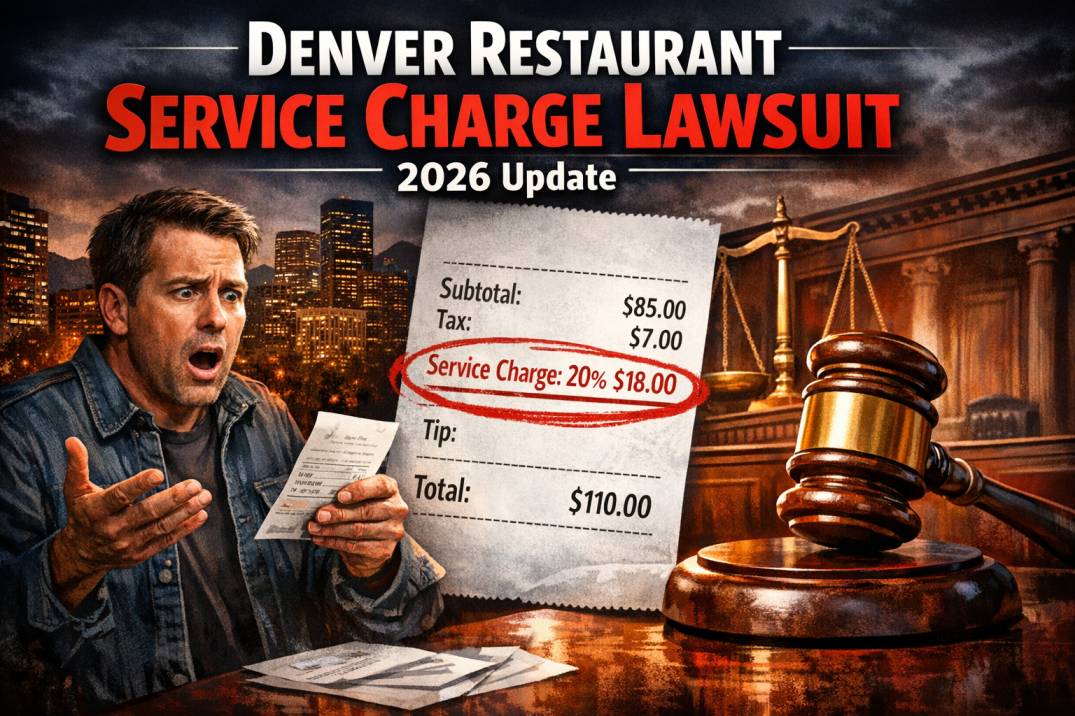
You’re out to dinner. The food is great, the service is warm, and when the bill arrives, you notice a 20% service charge already added on. No problem, you think — that’s going to the hardworking staff who made your night.
But what if it wasn’t?
That’s exactly the question at the heart of the Denver restaurant service charge lawsuit — a legal battle that started with a few frustrated servers and ended up exposing a much bigger problem about how mandatory fees are used, disclosed, and regulated across Colorado’s booming restaurant scene.
This article covers everything: who sued whom, why, what Colorado law actually says about service charges, how the case ended in 2026, and what it all means for workers and diners going forward.
Table of Contents
What Is the Denver Restaurant Service Charge Lawsuit About?
At its core, this Denver Restaurant Service Charge Lawsuit is about trust and transparency.
Culinary Creative Group (CCG) — the Denver-based restaurant company behind popular spots like Kumoya, Tap & Burger, Señor Bear, Mister Oso, Fox and the Hen, Forget Me Not, and Bar Dough — had been adding an automatic 20% service charge to every customer’s bill. Their menus stated this fee was “distributed to staff in an equitable manner.”
Former employees say that promise was misleading. They allege that a significant chunk of that service charge was quietly routed to management — not to the servers, bartenders, and kitchen workers who customers assumed were benefiting.
The lawsuit, filed in February 2025, accused CCG of violating Colorado wage and hour laws. It quickly became one of the most talked-about labor disputes in Denver’s hospitality industry.
Who Are the People Behind Denver Restaurant Service Charge Lawsuit Case?
The Plaintiffs
Several former CCG employees stepped forward as plaintiffs, but three names stand out:
Marianna White was a server at Kumoya, CCG’s high-concept Japanese restaurant in Denver’s Highland neighborhood. She was among the first to file a formal lawsuit. White said customers were being misled into thinking their 20% charge was going directly to floor staff — when the reality, she alleged, was quite different.
Faith Lindstrom started at Kumoya in the fall of 2023. She worked expo, served tables, acted as a barista, and filled in as a host. She was excited to be part of what felt like a trendy, progressive restaurant group. That excitement quickly turned to frustration when she started asking questions about the service charge and couldn’t get straight answers.
Hailey Jamieson began working at Fox and the Hen around the same time. Like Lindstrom, she believed the service charge system would benefit her. When January 2024 came and her hourly wages were cut by roughly $3 — dropping her from regular minimum wage to tipped minimum wage — she quit.
All three were represented by attorney Adam Harrison of HKM Employment Attorneys. Harrison later said that dozens of other former CCG employees had contacted him with similar complaints after the case became public.
The Defendant
Culinary Creative Group (CCG) is run by founder and CEO Juan Padró. The company positions itself as an inclusive, equitable employer — one that uses service charges specifically to ensure back-of-house employees like line cooks and dishwashers get a fair share of revenue, not just front-of-house staff who traditionally benefit from tipping.
Padró denied all allegations of wrongdoing. His position throughout was that CCG’s practices were both legal and clearly disclosed.
What Did the Denver Restaurant Service Charge Lawsuit Actually Alleged?
The Denver Restaurant Service Charge Lawsuit wasn’t based on a single complaint. It contained several distinct legal claims:
1. Misrepresentation of Where the Money Was Going
CCG’s menus and receipts described the 20% service charge as being “distributed to staff in an equitable manner.” The plaintiffs argued this language was deliberately vague — and deliberately misleading.
According to the lawsuit, approximately 30% of the service charge was being paid to managers. CCG later clarified in court filings that the actual figure was closer to 10%, but acknowledged that some management pay did come from service charge funds.
Either way, employees and customers were not clearly told that any portion was going to managers rather than non-managerial workers.
2. Wage Reduction and Tipped Minimum Wage Issues
In January 2024, CCG allegedly reduced hourly pay for front-of-house employees by approximately $3 per hour — shifting them from the standard minimum wage to Colorado’s lower tipped minimum wage.
Under Colorado law, employers can pay tipped workers less than full minimum wage — but only under specific conditions, and only by up to $3.02 per hour (the “tip credit”). The Denver Restaurant Service Charge Lawsuit argued that because the service charge was being used as part of employee compensation, this wage reduction was improper and manipulative.
3. Denial of Mandatory Rest Breaks
Colorado law requires employers to provide paid rest breaks to employees. Multiple plaintiffs alleged that CCG routinely failed to provide these breaks.
Hailey Jamieson described it plainly: getting a break at CCG was “like pulling teeth.”
The lawsuit sought compensation for all missed rest periods in addition to unpaid wages.
4. Wage Theft Through Deceptive Service Charge Practices
Attorney Adam Harrison argued that because customers likely believed the service charge was functioning like a tip — going directly to floor staff — the practice amounted to a form of wage theft by deception. Customers weren’t leaving additional tips because they thought they already had. Meanwhile, servers were taking home less than expected because management was taking a portion of the pool.
CCG’s Defense: What Did the Company Say?
Culinary Creative Group pushed back firmly on every allegation.
CEO Juan Padró issued a statement defending CCG’s practices, arguing that service fees are explicitly labeled as “service fees” on all guest checks — not tips — and that a completely separate line exists for discretionary gratuities. Under Colorado law, service charges are not legally defined as tips, which gives employers more discretion in how they distribute them, including paying managers from the pool.
Padró also argued that the service charge model was created to benefit the restaurant’s most vulnerable workers — dishwashers, line cooks, and prep staff who traditionally miss out on the tip windfall that front-of-house staff enjoy. In his view, the model was progressive, not exploitative.
“We have never misappropriated a single penny of employee tips,” Padró stated publicly.
CCG disputed both the 30% figure (stating management pay was approximately 10% of the service charge), the claim that rest breaks were routinely denied, and any suggestion that wages were improperly manipulated.
What Does Colorado Law Actually Say About Service Charges?
This case shone a spotlight on a corner of employment law that most people — including restaurant workers — don’t fully understand. And the legal answer turns out to be more nuanced than most media coverage suggested.
Under Colorado’s Wage and Hour Law (specifically INFO #3C: Tips, Gratuities, and Tipped Employees), the legal distinction between a tip and a service charge is clearly defined:
A tip is a voluntary payment made by a customer entirely at their own discretion. Legally, tips belong to the employee. Employers cannot keep them, direct them to managers, or use them to offset wages without following strict state guidelines.
A mandatory service charge is legally something different. Because customers have no choice but to pay it, it is treated as part of the cost of the meal or service — like a menu price. Colorado law does not classify mandatory service charges as tips. This means employers have significantly more discretion over how service charge money is distributed — yes, including paying managers.
This is exactly what CCG relied on in its legal defense. And on that narrow point, the law was on its side.
The real dispute wasn’t whether the practice was technically legal. It was whether customers and employees were honestly informed about how that money was being used. When a menu says a service charge is “distributed equitably among staff,” reasonable people — whether servers or diners — understand “staff” to mean the workers actually serving them. If management is taking 10–30%, that understanding is being violated even if no law is technically broken.
For restaurant workers who want to understand their broader employment rights, our guide on Legal Advice Basics is a good starting point before something goes wrong.
The Full Timeline: From Hiring to Arbitration
Fall 2023: Faith Lindstrom and Hailey Jamieson begin working at separate CCG restaurants. Both are told the 20% service charge will be distributed fairly among all staff — front-of-house and back-of-house alike.
January 2024: CCG reduces hourly wages for front-of-house employees by approximately $3, moving them to tipped minimum wage. Staff raise concerns about service charge distribution and can’t get clear answers from management. Some employees walk out. Lindstrom and Jamieson both quit.
February 2025: Former employees file a formal lawsuit against CCG in Colorado court, alleging violations of state wage and hour laws. Attorney Adam Harrison files separate but related claims on behalf of multiple plaintiffs.
March 2025: CBS News Colorado breaks the story. Coverage spreads nationally. Dozens more former CCG employees contact plaintiff attorneys with similar complaints.
Mid-to-late 2025: The lawsuit is placed on hold while both parties dispute whether employees signed binding arbitration agreements during onboarding that would move the dispute out of open court. This procedural fight is significant — arbitration is private, typically faster, and generally favors employers over individual workers.
Late 2025: CCG begins updating its receipt language at Kumoya and other locations to be more explicit. New language reads: “The 20% service charge on your check enables us to fairly compensate every team member who contributes to your experience. It is not a tip or gratuity. Any tip you leave is given entirely to the front-of-house team under Colorado law.”
March 25, 2026: The lawsuit is formally dismissed from public court and transferred to private arbitration. Judge Sarah Block Wallace declines to make a final legal determination on the service charge question, citing possible jurisdictional limits. Both parties agree to cover their own legal costs.
The case closes without a formal finding of misconduct against CCG. But it does not close without impact.
What Actually Changed Because of the Denver Restaurant Service Charge Lawsuit?
Despite ending in arbitration rather than a public verdict, this lawsuit changed things. Several of them.
Clearer receipts across CCG restaurants. The updated language now explicitly tells customers the service charge is not a tip and that any additional gratuity they leave goes fully to front-of-house staff. That’s a concrete, customer-facing improvement driven entirely by legal pressure.
A negotiated legal standard. During the arbitration process, both sides — despite their disagreements — agreed on language that defines what a properly disclosed service charge should look like. Attorney Harrison called it a template that could guide future disputes and help both employers and employees understand the line between legal and misleading.
Industry-wide attention. This case was covered by CBS News, Denverite, Business Insurance, Legal Reader, and Moneywise, among others. It became a national reference point in conversations about how restaurant service charges should be handled — long before any legislation was passed.
Potential regulatory scrutiny. The case may prompt Colorado’s Department of Labor and Employment to revisit its guidance on mandatory service charges. If clearer enforcement rules emerge, workers across the state will benefit.
This kind of outcome — where a lawsuit drives behavioral change even without a formal win — is actually more common than people realize in employment law. We saw a similar dynamic in the Health Matching Account Class Action Lawsuit, where legal pressure forced policy changes before any final ruling was handed down.
The Bigger Picture: Service Charges Are Everywhere Now — And Growing
The CCG case didn’t happen in isolation. It happened against the backdrop of a rapidly changing restaurant industry.
According to a 2024 National Restaurant Association survey, 16% of restaurant owners now use service charges or surcharges — a figure that has been growing steadily since 2022. In Denver alone, the practice has appeared at places ranging from bartaco to Casa Bonita, which adds a 15% charge on top of an already-included minimum admission cost.
Restaurant owners have legitimate reasons for preferring service charges over traditional tipping. Rising labor costs, wafer-thin profit margins, and the perceived unfairness of a tipping system that richly rewards front-of-house staff while leaving kitchen workers behind — these are real problems. Service charges, in theory, offer a more equitable solution.
The problem is in the execution.
Study after study shows that diners are deeply confused about service charges — whether tipping is still expected on top of them, whether the charge goes to the person who served them, and whether they can decline to pay. That confusion breeds distrust. And when companies take advantage of that confusion rather than resolving it, legal exposure follows.
The CCG lawsuit is a case study in what happens when a restaurant group gets the policy right in theory but fails badly on disclosure and communication. The service charge model itself was not the problem. The lack of honest, clear explanation to both customers and employees was.
What This Means If You’re a Restaurant Worker
If you work in Colorado’s restaurant industry, this case has direct implications for your paycheck and your legal rights.
Know the difference between a tip and a service charge. Tips are legally yours. Your employer cannot redirect them to managers or keep them. Service charges are legally different — your employer has more flexibility — but that flexibility has limits, especially if they’ve made representations about how the money will be used.
Watch your base wage carefully. If your employer implemented or raised a service charge and simultaneously cut your hourly rate, that combination is worth examining. Colorado law permits a tip credit — but only under specific conditions and not as a tool to manipulate overall compensation.
You have the right to know how funds are distributed. If your employer describes a service charge as going to “staff” or being “equitably distributed,” you’re entitled to ask how it’s actually calculated and distributed. Vague or evasive answers may themselves be a warning sign.
Rest breaks are not optional in Colorado. If you’re missing mandatory paid breaks regularly, you may be entitled to back pay. Document every missed break.
Read what you sign. Arbitration agreements in employment contracts are increasingly common and can significantly affect your options if a dispute arises. Understanding what you agree to on day one matters far more than people realize.
What This Means If You’re a Diner
Customers aren’t powerless in this equation either.
Look at your receipt carefully. If a service charge and a tip line both appear on your bill, understand that these are legally different. The service charge may not go to the person who served you. Your additional tip, under Colorado law, does go to front-of-house staff.
Ask where the service charge goes. Good restaurants will tell you clearly. The fact that CCG updated its receipts after this lawsuit proves that public pressure works. If a restaurant can’t explain its own service charge policy, that’s worth noting.
Your reviews and spending habits matter. Economic feedback from diners has historically been one of the fastest drivers of change in the restaurant industry. If transparency matters to you, let it show in how you spend — and what you say publicly.
How This Case Fits Into a Larger Pattern
The Denver restaurant service charge lawsuit isn’t an isolated incident. It’s part of a growing wave of legal disputes in which workers allege that companies misrepresent how mandatory fees, charges, or funds are collected and distributed.
We’ve covered a similar pattern in the Nightfall Group Lawsuit, where allegations of financial misrepresentation inside a business created broad legal exposure across multiple parties. In both cases, the central question is the same: when a company promises you that money is going to a specific place, are they being truthful?
Legal accountability — even when it ends in arbitration rather than a courtroom verdict — creates pressure that changes behavior. That’s not nothing. That’s, arguably, exactly what the legal system is for.
Frequently Asked Questions
Who filed the Denver restaurant service charge Denver Restaurant Service Charge Lawsuit?
The lawsuit was filed in February 2025 by former employees of Culinary Creative Group, including server Marianna White, Faith Lindstrom, and Hailey Jamieson. They were represented by attorney Adam Harrison of HKM Employment Attorneys.
Which Denver restaurants were involved in this Lawsuit?
CCG operates Kumoya, Tap & Burger, Señor Bear, Mister Oso, Forget Me Not, Fox and the Hen, and Bar Dough, among others.
What was the final outcome for Denver Restaurant Service Charge Lawsuit?
In March 2026, the lawsuit was dismissed from public court and moved to private arbitration. No formal finding of misconduct was issued against CCG, and both parties agreed to cover their own legal costs.
Did anything actually change because of this Denver Restaurant Service Charge Lawsuit?
Yes. CCG updated its receipt language to explicitly state that the 20% service charge is not a tip and that any additional tip goes entirely to front-of-house staff. The case also produced a negotiated legal standard that both parties agreed could serve as a template for future disputes.
Are mandatory service charges legal in Colorado?
Yes. Under Colorado law, mandatory service charges are not classified as tips. They are part of the cost of service, and employers have broad discretion over how they are distributed — including paying managers from service charge funds — as long as the policy is properly disclosed to employees and customers.
Can employers reduce wages if they collect service charges?
Only under specific circumstances. Colorado allows a “tip credit” that permits employers to pay tipped employees slightly below standard minimum wage — but only if tips bring total compensation up to or above minimum wage. Using service charges to manipulate this calculation improperly is exactly what this lawsuit challenged.
What should workers do if they suspect wage violations?
Document everything — hours worked, pay stubs, any written communications about service charges or wages. If something feels wrong, consult an employment attorney. Colorado has strong wage protection laws, but enforcing them starts with understanding your rights.
Final Thoughts
The Denver restaurant service charge lawsuit didn’t end with a headline-grabbing verdict or a massive payout. What it produced was something quieter — and arguably more durable: a clearer receipt, a negotiated legal standard, and a public record of what happens when businesses prioritize convenience over honest communication with the people who work for them and the customers who trust them.
Service charges in restaurants are not going away. They’re going to become more common as labor costs rise and the traditional tipping model continues to show its limitations. That doesn’t have to be a bad thing. A well-designed, honestly disclosed service charge can genuinely create more equitable pay across a restaurant’s entire team.
But “well-designed and honest” is the key phrase. The Denver Restaurant Service Charge Lawsuit drew a line — not a legal one, since no court ruling was issued, but a practical and reputational one — between service charges that serve workers and service charges that merely look like they do.
The servers who filed this Denver Restaurant Service Charge Lawsuit weren’t chasing fame or a payout. They were asking a simple question that every worker deserves an honest answer to: where does my money actually go?
Because of them, the answer in Denver restaurants — and hopefully beyond — is now a little more clear.
Disclaimer: This article is for informational purposes only and does not constitute legal advice. If you believe your employer has violated wage or labor laws, consult a qualified employment attorney in your jurisdiction.