
The United States Air Force is not found in the Constitution at all. The Federal Bureau of Investigation is also not there. You will not find the Federal Reserve in the Constitution either. The National Aeronautics and Space Administration does not have any text in the Constitution to support it.
As we all know, the Internal Revenue Service, the Environmental Protection Agency and the Federal Communications Commission. None of these organizations are mentioned by name in the document that is supposed to be the law of the land. The United States Air Force and the Federal Bureau of Investigation are a few examples of this.
Yet all of them are perfectly legal. All of them are constitutional. And millions of Americans interact with them every single day.
How is that possible?
The simple answer is implied powers — one of the most consequential, most debated, and least-understood concepts in American constitutional law. Once you understand implied powers, you understand why the federal government looks the way it does today. You also understand why the debates over federal overreach, states’ rights, and constitutional limits are never really going to end.
Let’s get into it.
Table of Contents
What Are Implied Powers?
Implied powers are the powers of the federal government that are not explicitly written in the Constitution, but are logically necessary to carry out the powers that are written there.
Think of it this way. The Constitution gives Congress the power to raise and maintain an army. That is written directly into Article I, Section 8. But what happens when warfare moves to the skies? The Founders wrote that clause in 1787 — they had never seen an airplane. Nowhere does the Constitution say Congress can create an Air Force.
But it would be absurd to say Congress cannot maintain military air power just because the Founders did not predict the invention of aircraft. The power to create and fund an Air Force is implied by the express power to raise and maintain a military. It is necessary to make that express power work in the modern world.
The main idea of implied powers is that if the Constitution sets a goal, for something it also gives you the things you need to achieve that goal. This is true even if those things are not directly mentioned in the Constitution. The Constitution gives you a goal. It also gives you the reasonable tools to reach that goal, which is the core logic of implied powers.
Other names you’ll see for implied powers: Inherent powers, inferred powers, or “powers derived from the Necessary and Proper Clause.” They all refer to the same concept.
The Elastic Clause: The Source of All Implied Powers
Implied powers do not come from thin air. They have a specific constitutional home: Article I, Section 8, Clause 18 — known as the Necessary and Proper Clause, or more commonly, the Elastic Clause.
Here is the exact text:
“[Congress shall have power] To make all Laws which shall be necessary and proper for carrying into Execution the foregoing Powers, and all other Powers vested by this Constitution in the Government of the United States, or in any Department or Officer thereof.”
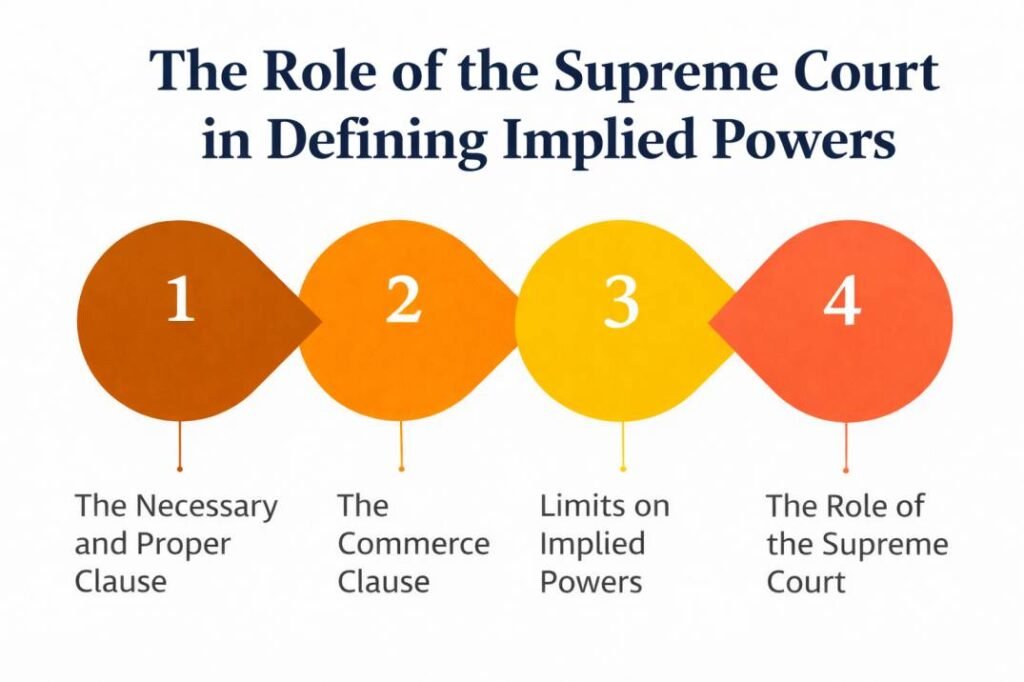
Two words carry all the weight here: necessary and proper.
The Congress has the power to do a lot of things that are not even listed in the Constitution. It can do anything that’s necessary and proper to make the things that are listed in the Constitution actually happen.
The Congress is talking about the things that are written in the Constitution. It has the power to do what it needs to do to make these things work. This one little part of the Constitution is the basis for thousands of laws many big agencies and over two hundred years of the federal government getting bigger. The Congress uses this part of the Constitution to do what it thinks is necessary and proper to make the things, in the Constitution happen.
Modern privacy disputes like the Life360 case show how states often step in when federal law does not fully regulate consumer data protection and surveillance practices.
Why Is It Called the Elastic Clause?
Because it stretches. Unlike the rest of Article I, Section 8, which lists specific, defined powers, Clause 18 is deliberately open-ended. The Founders knew they could not anticipate every future situation the country would face. So they wrote a clause that could expand Congressional authority as circumstances changed — like elastic.
It is also one of the most argued-over clauses in constitutional history. Every major expansion of federal power — from the creation of a national bank in 1791 to the regulation of the internet today — has been justified, at least in part, by this clause.
Implied Powers vs Expressed Powers: What Is the Actual Difference?
Before going further, it helps to be clear on the distinction. The Constitution gives Congress two types of powers:
| Expressed Powers | Implied Powers | |
| What they are | Explicitly written in the Constitution | Not written, but logically derived from expressed powers |
| Where found | Article I, Section 8, Clauses 1–17 | Derived from Clause 18 (Necessary & Proper) |
| Example | Power to coin money | Power to create the Federal Reserve to manage that money |
| Legal basis | Direct constitutional text | McCulloch v. Maryland (1819) + long precedent |
In plain terms: expressed powers are the what. Implied powers are the how. The Constitution tells Congress what it can do. Implied powers give Congress the tools to actually do it.
For a deeper look, see our guide: Expressed Powers: Definition, Examples, and Importance in U.S. Government
The Case That Defined Implied Powers: McCulloch v. Maryland (1819)
No discussion of implied powers is complete without this case. It is the foundation of everything.
Here is the backstory. In 1816, Congress chartered the Second Bank of the United States. The state of Maryland did not like it — a federal bank on Maryland’s soil felt like an overreach. So Maryland passed a law taxing the federal bank heavily, hoping to make it unworkable. James McCulloch, the cashier of the Baltimore branch of the bank, refused to pay the tax. Maryland took him to court.
The case went all the way to the Supreme Court. Two huge questions were at stake:
- Does Congress even have the power to create a national bank? (The word “bank” appears nowhere in the Constitution.)
- Can a state tax a federal institution?
Chief Justice John Marshall wrote the opinion. His answer to the first question became the cornerstone of implied powers doctrine.
Marshall argued that the Necessary and Proper Clause gave Congress the flexibility to choose its own means for carrying out its listed powers. The Constitution grants Congress the power to tax, to regulate commerce, to pay national debts. A national bank is a reasonable — even obvious — tool for doing all of those things. Therefore, Congress has the implied power to create one.
His now-famous line:
“Let the end be legitimate, let it be within the scope of the Constitution, and all means which are appropriate, which are plainly adapted to that end, which are not prohibited, but consistent with the letter and spirit of the Constitution, are constitutional.”
To the second question — no. A state cannot tax the federal government. As Marshall put it: “the power to tax involves the power to destroy.” If states could tax federal institutions out of existence, the whole system falls apart.
Why McCulloch still matters today: Every time Congress creates a new agency, passes a new regulation, or extends federal authority into a new area, it is relying on the logic Marshall established in 1819. The case gave the federal government room to grow with the country.
Real-World Examples of Implied Powers
This is where it gets concrete. Implied powers are not just a constitutional theory — they show up in real institutions and laws you interact with constantly.
The U.S. Air Force
The Constitution says Congress can raise and support armies and maintain a navy. It says nothing about air power. The Air Force was created in 1947, 160 years after the Constitution was written. Its constitutional basis? The implied power to maintain military strength, derived from the expressed power to defend the nation.
The Federal Reserve
Congress has the expressed power to coin money and regulate its value. The Federal Reserve System — created in 1913 — manages the entire monetary policy of the United States. It sets interest rates, supervises banks, and controls the money supply. None of this is written in the Constitution. All of it flows from the implied power to manage the currency system that the expressed power to coin money creates.
The FBI
Congress has the power to regulate interstate commerce and to define and punish crimes. The FBI was created in 1908 to investigate federal crimes that cross state lines. No article of the Constitution names the FBI. But the implied power to enforce federal law — derived from the expressed powers to create laws and regulate commerce — is its constitutional home.
The IRS
The 16th Amendment gave Congress the power to levy income taxes. The Internal Revenue Service is the agency created to actually collect those taxes. Congress did not need a separate constitutional amendment to create it. The IRS exists as an implied tool of the expressed taxing power.
The EPA and Other Federal Agencies
The Environmental Protection Agency, the Food and Drug Administration, the Federal Communications Commission — none of these are in the Constitution. They all exist as implied tools for exercising expressed powers. The EPA enforces environmental law derived from the Commerce Clause. The FDA regulates food and drugs in interstate commerce. The FCC regulates the airwaves that cross state lines.
The Interstate Highway System
Congress has the power to establish post roads and regulate interstate commerce. The 47,000-mile Interstate Highway System, created under President Eisenhower in 1956, was justified as both — a postal route and a commercial artery. Implied powers made it possible.
Strict vs. Loose Construction: The Political Fight Behind Implied Powers
From the very beginning, implied powers were politically explosive. The debate started before the ink on the Constitution was dry.
Alexander Hamilton’s Loose Construction
When Hamilton proposed the first national bank in 1791, Thomas Jefferson and James Madison objected loudly. Jefferson argued for strict construction: if the Constitution does not explicitly give Congress a power, Congress does not have it. Period.
Hamilton fired back with loose construction: the Necessary and Proper Clause exists precisely to give Congress the flexibility to do what is needed. “Necessary” does not mean “absolutely indispensable” — it means “useful, conducive to, or naturally related to.” Washington sided with Hamilton. The bank was created.
The Debate That Never Ended
That argument between Hamilton and Jefferson is essentially still happening. Every debate about “federal overreach,” every Supreme Court case about whether Congress went too far, every argument about the size of government — at the root of all of them is the question: how elastic is the Elastic Clause?
Strict constructionists say implied powers must stay close to the specific expressed powers they derive from. Loose constructionists say Congress has broad latitude to choose its own means as long as the goal is constitutional. The Supreme Court has generally sided with loose construction since McCulloch — but not without limits.
Implied Powers Are Not Unlimited
Here is the part that gets left out of a lot of explanations: implied powers have real boundaries.
Marshall’s test in McCulloch set the standard. An implied power is constitutional only if it meets all three of these conditions:
1. The end must be legitimate. The goal Congress is trying to achieve must fall within the scope of its expressed powers. Congress cannot invent entirely new powers by creative interpretation.
2. The means must be appropriate. The tool Congress is using must actually relate to the goal. A law that is wildly disconnected from any expressed power cannot be rescued by the Necessary and Proper Clause.
3. The means must not be prohibited. Implied powers cannot override explicit constitutional limits. Congress cannot use implied powers to violate the Bill of Rights, infringe on Reserved Powers of the states, or act contrary to other constitutional provisions.
The Supreme Court has struck down federal laws that went too far. In United States v. Lopez (1995), the Court struck down the Gun-Free School Zones Act, ruling that carrying a gun near a school was not economic activity affecting interstate commerce. Congress had stretched the Commerce Clause — and implied powers derived from it — beyond what the Constitution would allow.
So the picture is more nuanced than “Congress can do anything.” Implied powers are real and broad, but they are not a blank check.
Implied Powers and Reserved Powers: The Permanent Tension
Every time the federal government exercises an implied power, it is potentially stepping into territory that the states believe belongs to them.
The Tenth Amendment is explicit: powers not delegated to the federal government are reserved to the states and the people. And Reserved Powers — the powers that states retain — are the counterweight to implied powers at the federal level.
When Congress creates an environmental regulation, is that a legitimate implied power derived from the Commerce Clause? Or is it an unconstitutional intrusion into state police powers? When Congress passes federal education funding conditions, is that proper use of the spending power? Or is it commandeering a reserved state function?
These questions do not have clean answers. The boundary between federal implied powers and state reserved powers is the most contested line in American constitutional law. Courts draw it differently in different eras. Administrations push it in different directions depending on their politics.
What you need to understand is this: implied powers and reserved powers are in permanent tension by design. The Founders built that tension into the Constitution intentionally. They wanted the federal government to have enough flexibility to function — but not so much power that it could swallow the states.
Implied Powers vs. Concurrent Powers
One more distinction worth clarifying, since these concepts often get mixed up.
Concurrent Powers are powers that both the federal government and the states share. Taxing is the clearest example — both the IRS and your state’s revenue department can tax you. Both Congress and state legislatures can pass criminal laws.
Implied powers are different. They belong exclusively to the federal government, derived from its expressed powers through the Elastic Clause. A state cannot claim an implied power based on federal constitutional text.
Think of it this way:
- Concurrent powers = both levels of government have the same power (taxation, law enforcement)
- Implied powers = federal government’s power to do things not explicitly listed, derived from what is listed
Implied Powers in 2026: Why This Still Matters
If implied powers feel like a settled historical concept, think again. They are at the center of some of the biggest legal and political fights happening right now.
Federal Regulation of the Internet
No provision of the Constitution mentions the internet, social media, or digital commerce. Yet Congress has passed laws regulating online platforms, data privacy, and cybersecurity. All of it rests on implied powers derived from the Commerce Clause. Whether those regulations go too far — or not far enough — is actively litigated.
Federal Drug Policy vs. State Legalization
Dozens of states have legalized marijuana. The federal government still classifies it as a Schedule I controlled substance. The federal ban rests on implied powers under the Commerce Clause, including a 2005 Supreme Court case (Gonzales v. Raich) that held Congress can regulate even purely local marijuana cultivation because of its effect on the broader interstate market. The tension between federal implied powers and state reserved powers here is ongoing and unresolved.
Federal Healthcare Regulation
The entire structure of the Affordable Care Act, Medicare, and Medicaid involves implied powers at every level. When the ACA was challenged in NFIB v. Sebelius (2012), the Supreme Court had to decide whether the individual mandate fell within implied powers under the Commerce Clause. The answer — narrowly yes, but only under the taxing power — showed just how live these questions remain.
FAQ — Implied Powers
What is the simple definition of implied powers?
Implied powers are federal government powers that are not written in the Constitution but are necessary to carry out the powers that are. They come from the Necessary and Proper Clause (Article I, Section 8, Clause 18).
What is the difference between implied powers and expressed powers?
Expressed powers are explicitly listed in the Constitution (like the power to declare war or coin money). Implied powers are not listed but are logically necessary to use the expressed powers effectively.
Why is the Necessary and Proper Clause called the Elastic Clause?
Because it can stretch. Unlike the specific powers listed in Article I, the Necessary and Proper Clause is deliberately broad — it allows Congress to use any means that is appropriate and related to an expressed power, giving it flexibility to adapt to new situations.
What Supreme Court case established implied powers?
McCulloch v. Maryland (1819). Chief Justice John Marshall ruled that Congress had the implied power to create a national bank under the Necessary and Proper Clause, even though banks are not mentioned in the Constitution.
Are implied powers unlimited?
No. They must meet three criteria from McCulloch: the goal must be legitimate, the means must be appropriate, and the means must not be constitutionally prohibited. Courts have struck down laws that stretched implied powers too far.
What is the difference between implied powers and reserved powers?
Implied powers allow the federal government to act beyond its written list. Reserved powers (protected by the Tenth Amendment) guarantee that states keep the powers not given to the federal government. Learn more: What Are Reserved Powers?
What are the best examples of implied powers?
The U.S. Air Force, the FBI, the Federal Reserve, the IRS, the EPA, NASA, and the Interstate Highway System are all classic examples of federal institutions that exist through implied powers rather than explicit constitutional text.
How do implied powers relate to the Tenth Amendment?
The Tenth Amendment says powers not given to the federal government are reserved to the states. Every time the federal government claims an implied power, it must not infringe on those reserved state powers.
Conclusion
The Constitution is a living document. Implied powers are what make it work. The people who wrote the Constitution, the Founders, were very smart. They could not think of every single situation that would come up in the future. So they added a clause that gives Congress some room to make decisions.
This clause is short and simple. It is very important. It allows Congress to do things that are not specifically written in the Constitution. The Air Force, the Federal Reserve, the FBI and the highway system that connects all the states are all examples of things that’re not in the Constitution.. They are all allowed because of implied powers.
But implied powers are not a free pass. They have limits. They cannot override the Tenth Amendment’s protection of Reserved Powers. They cannot violate the Bill of Rights. They must genuinely connect to an expressed power. And every generation will argue about exactly where those limits fall.
That argument — about what the federal government can and cannot do — is one of the oldest and most important conversations in American democracy. Implied powers are right at the center of it.
For more on how powers are divided in the U.S. Constitution, explore our Constitutional Law hub or read our guide on Concurrent Powers.