
There’s a moment that hundreds of GM truck owners have described almost identically. They’re on the highway — sometimes with their family in the car — and without any warning light, without any unusual sound leading up to it, the engine just stops. The dashboard goes dark. The power steering cuts out. They’re coasting at 65 miles per hour with no control, trying to get to the shoulder before something terrible happens.
That moment is at the heart of the General Motors V8 engine lawsuit. And what makes it a lawsuit rather than just a sad story is what GM allegedly knew — and for how long.
Table of Contents
How Did We Get Here?
General Motors introduced the L87 engine back in 2019. It’s a 6.2-liter V8 — a naturally aspirated powerplant that went into some of GM’s most popular and expensive vehicles. The Silverado 1500, the GMC Sierra, the Cadillac Escalade. These aren’t cheap trucks. Some of them cost six figures. People who bought them expected them to last.
For a while, the L87 had a solid reputation. But somewhere in the manufacturing process, something went wrong — and according to court filings, GM knew about it far earlier than the company let on publicly.
The defect itself comes down to two problems that compound each other. First, the crankshafts in some of these engines were machined outside of acceptable tolerances. In plain English, the parts weren’t made to the right dimensions. Second, during manufacturing, metal debris got into the oil passages of the crankshaft and connecting rods. When those passages get blocked, oil can’t reach the bearings that need lubrication to function.
Put both problems together and you have an engine that is slowly — or sometimes very quickly — destroying itself from the inside. The bearings fail. The engine seizes. And the driver has no idea it’s coming.
One NHTSA complaint cited in legal filings captures it bluntly: a driver was on the freeway when the truck suddenly shut off completely. There was nowhere to pull over. He was stopped in the middle of the highway with his family in the car. The engine never restarted.
What the General Motors V8 Engine Lawsuit Actually Claims
The main consolidated case — Powell v. General Motors — is being heard in the U.S. District Court for the Eastern District of Michigan. It brings together 11 separate class action complaints filed throughout 2025, all pointing to the same underlying defect in the L87 engine.
The legal claims aren’t complicated to understand, even if the engineering behind them is. Plaintiffs are essentially arguing three things.
GM knew. The General Motors V8 Engine Lawsuit alleges the company was internally aware of the L87’s bearing problems as far back as 2021. Internal GM documents cited in the filings show the automaker had been tracking this issue for years. GM even published a bulletin on its TechLink platform — the private communication channel used to update dealer service technicians — warning that knocking or thumping sounds in certain models could indicate crankshaft bearing failure. Dealers were warned. Customers were not.
GM kept selling. Despite allegedly knowing about a defect that could cause complete engine failure at highway speed, GM continued to sell affected vehicles without disclosing the problem to buyers. If consumers had known, the argument goes, they either wouldn’t have purchased the vehicle at all or would have paid significantly less for it.
The recall didn’t fix it. In May 2025, GM issued Recall N252494000, covering around 597,630 vehicles. The proposed remedy was switching to a thicker grade of engine oil. Plaintiffs’ attorneys called this insufficient — and their reasoning is hard to argue with. If the crankshaft is physically machined to the wrong size, heavier oil might slow the damage, but it doesn’t correct the underlying dimensional problem. The parts are still out of spec.
The Numbers Are Hard to Ignore for General Motors V8 Engine Lawsuit
By April 2025, GM had received 28,102 complaints or incident reports tied to the L87 engine. Over 14,000 of those involved complete loss of propulsion — the engine dying while the vehicle was in motion. There were 42 fires, 12 crashes, and 12 injuries documented in those reports.
The NHTSA launched its own preliminary investigation in January 2025 after receiving 39 consumer complaints about sudden bearing failures. By October of that year, the agency had independently logged 1,157 reports of bearing failures linked to the L87, including four crashes and fires directly attributed to engine failure.
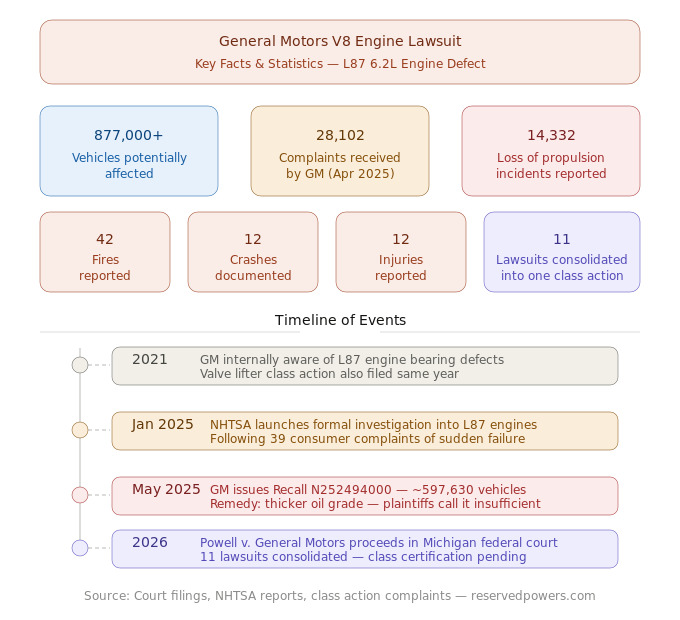
877,000 vehicles. That’s roughly the population of a mid-sized American city — all driving around in trucks and SUVs with engines that might fail without warning.
One of the earlier individual lawsuits, filed before the cases were consolidated, sought $5 million in damages. The eventual liability in the consolidated class action, if plaintiffs prevail, could be many times that.
Which Vehicles Are Actually Affected in General Motors V8 Engine Lawsuit?
This is what most people reading this actually want to know. The affected vehicles — all equipped with the L87 6.2L V8 engine — span several model years across GM’s major truck and SUV lineup.
The 2019 through 2024 Chevrolet Silverado 1500 and GMC Sierra 1500 are included, along with the 2021 through 2024 Chevrolet Tahoe, Chevrolet Suburban, GMC Yukon, GMC Yukon XL, Cadillac Escalade, and Cadillac Escalade ESV. Some filings also extend the scope to include 2025 model years.
If your vehicle falls into any of those categories, checking your VIN at nhtsa.gov takes about 30 seconds and tells you immediately whether your specific truck is part of the recall.
This Isn’t the First Time GM’s V8s Have Had Legal Problems
The L87 bearing lawsuit isn’t happening in isolation, and that context matters.
Back in 2021, a separate class action was filed against GM over defective valve lifters in several of its small-block V8 engines — including the L87, the 5.3L L84, and the 6.0L Vortec L96. That lawsuit alleged the lifters were made of lightweight materials that wore out prematurely and were sometimes installed in incorrect positions. As of late 2025, that case had still not received class action certification — more than four years after it was filed.
Two separate lawsuits. Multiple V8 engine families. Both pointing to quality control failures in manufacturing. That pattern matters, because it becomes harder for GM to argue that a single defect was an isolated incident when there’s a documented history of related problems across its V8 lineup.
The situation is comparable to other major product liability cases where plaintiffs argued that corporations had internal knowledge of defects but prioritized sales over consumer safety — a dynamic seen in cases like the Roundup lawsuit and the Health Matching Account class action, where what a company knew and when became central to the legal outcome.
How This Compares to Other Auto Defect Cases
Auto defect litigation has a long history in American courts, and the GM V8 case fits a recognizable pattern. If you’ve followed the Ford F-150 oil consumption lawsuit, you’ll notice several of the same dynamics — alleged internal knowledge of an oil-related engine defect, a delayed public response, and a recall that owners argue doesn’t fully address the root problem.
What sets the GM case apart is scale. 877,000 potentially affected vehicles is a massive number. The consolidation of 11 separate lawsuits into one class action signals that the courts view this as a systemic problem, not a series of unrelated incidents. And the NHTSA’s involvement — combined with GM’s own internal communications being used as evidence — gives plaintiffs a strong factual foundation.
What Should GM Owners Do Right Now?
If you own an affected vehicle, the most important thing is not to ignore warning signs while the lawsuit plays out. Some engine failures have happened with very little mileage — one documented case involved failure at just 1,200 miles. Waiting for a knock you might not even hear before the engine goes isn’t a viable strategy.
Check your VIN at nhtsa.gov. If your vehicle is included in the recall, take it to a GM dealer and ask specifically about Recall N252494000. Get everything documented in writing — what was inspected, what was done, and when. That paper trail matters both for your safety and for any legal claim you might eventually pursue.
If you’ve already had engine failure or paid out of pocket for repairs, speak with an attorney. Law firms including Hagens Berman have been actively accepting cases on behalf of affected GM owners. If the class action moves forward, affected owners may be entitled to compensation for repairs, diminished vehicle value, rental car costs, and related expenses.
For a baseline understanding of your consumer rights before that conversation, the legal advice basics guide on this site is a practical starting point. And if your vehicle is registered in Michigan — the state where this litigation is being heard — understanding how state and federal automotive regulations interact, as explored in resources like Michigan car seat laws, can provide useful context for how state and federal law work together in vehicle safety cases.
Where Does the Case Stand?
As of early 2026, Powell v. General Motors is moving through the pretrial process in Michigan federal court. Plaintiffs are pushing for class certification — the legal determination that these cases can proceed as a group rather than individually.
GM has not publicly admitted fault in General Motors V8 Engine Lawsuit. The company has maintained that the oil specification change represents an appropriate response to the identified issue. Whether a judge — and potentially a jury — agrees with that position is what the litigation will decide.
What’s not in dispute is the scale of the problem. Tens of thousands of documented complaints. A federal safety investigation. Eleven lawsuits consolidated into one for General Motors V8 Engine Lawsuit. Crashes and fires in the record. This is not a case that gets quietly dismissed.
The Bigger Question for General Motors V8 Engine Lawsuit
Strip away the legal filings and technical specifications, and the General Motors V8 engine lawsuit is really about one question that runs through every major product liability case: when a company discovers that something it’s selling poses a safety risk, what does it do next?
Does it disclose the problem, accept the short-term financial hit, and work with regulators and customers to fix it? Or does it manage the information internally, keep selling, and deal with the fallout later?
The plaintiffs, the NHTSA complaints, and independent engineering analyses all point toward the latter. GM’s legal team will argue otherwise. That’s what courts are for.
But for the driver who was coasting down a freeway at 65 mph with a dead engine and his family in the backseat, the legal outcome doesn’t undo what happened. It can only determine whether GM is held accountable for it.
Frequently Asked Questions For General Motors V8 Engine Lawsuit
What is the lawsuit for the GM 6.2 liter V8 engine?
The lawsuit alleges that GM sold vehicles equipped with a defective 6.2-liter L87 V8 engine that can fail suddenly and without warning. Plaintiffs claim GM knew about the defect as far back as 2021 but continued selling affected vehicles without disclosing the problem to buyers.
Why does GM 6.2 fail?
Two manufacturing defects are responsible. First, the crankshaft was machined outside acceptable tolerances — wrong dimensions from the factory. Second, tiny metal particles (what technicians call “machining glitter”) got trapped inside the oil passages during manufacturing. Both issues cut off lubrication to the rod bearings. Without proper lubrication, the bearings grind, fail, and the engine seizes — sometimes at highway speed, sometimes with under 1,200 miles on the odometer.
Did GM lose $1.1 billion due to tariffs?
Yes. In Q2 2025, GM reported that President Trump’s auto import tariffs cost the company exactly $1.1 billion in a single quarter. This caused net income to drop 35%, and slashed GM’s profit margin from 9% down to 6.1%. GM CEO Mary Barra acknowledged the hit and said the company was working to offset the impact by increasing U.S. production and domestic content.
How much will I get from a GM class action lawsuit?
No fixed amount has been set yet — the case is still ongoing. Typically in auto defect class actions, owners receive compensation for repair costs, out-of-pocket expenses like towing and rentals, and diminished vehicle value. One individual lawsuit filed early on sought $5 million. Your payout depends on your specific damages and whether class certification is granted.
How to join GM class action lawsuit?
Check if your vehicle qualifies — you must own or lease a 2021–2025 GM vehicle with the 6.2L V8 L87 engine. If yes, contact a law firm handling this case — Hagens Berman is the court-appointed interim co-lead counsel. Consultation is free and you pay nothing out of pocket. Document all repair records, dealer visits, and related expenses before reaching out.
GM 6.2 lawsuit update?
As of early 2026, the consolidated complaint (Powell v. General Motors) was formally filed on February 26, 2026 in Michigan federal court. Hagens Berman was named co-lead counsel. The case is in early stages — no settlement has been reached yet. Meanwhile, NHTSA launched a new investigation in January 2026 questioning whether GM’s recall fix actually works, after 36 vehicles failed again even after receiving the official repair.
General Motors V8 engine lawsuit update
The consolidated class action officially commenced on March 1, 2026. NHTSA is now investigating whether GM’s recall remedy — switching to thicker 0W-40 oil — is even effective, since engines continued failing post-recall. A formal Engineering Analysis (RQ26001) was opened by NHTSA’s Office of Defects Investigation. If the oil fix is ruled insufficient, GM could be forced to replace engines in all 600,000 affected vehicles.
This article is on General Motors V8 Engine Lawsuit is for informational purposes only and does not constitute legal advice. If you own an affected vehicle or have experienced issues related to the GM V8 engine defect, consult a licensed attorney in your state.