
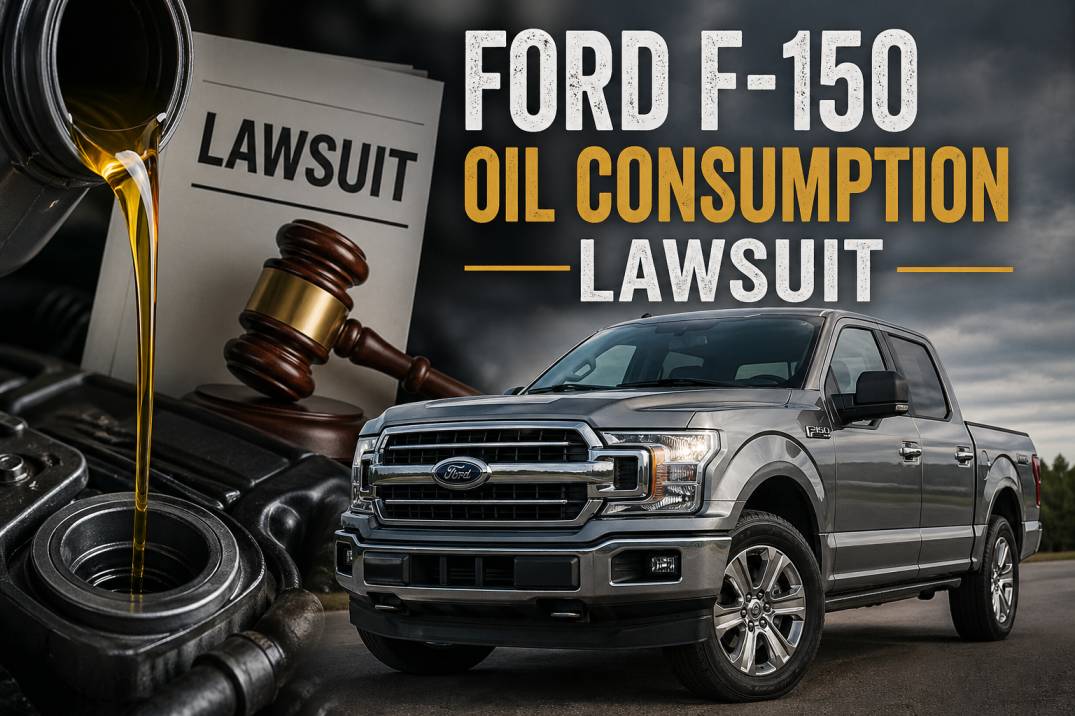
If you own a 2018, 2019, or 2020 Ford F-150 with the 5.0L V8 engine, there’s something you need to check right now — not next week, not at your next oil change. Right now.
Pull out your dipstick.
Thousands of owners just like you have opened their hoods expecting everything to be fine, only to find their oil two, sometimes three quarts low — between oil changes, with no external leaks, and no warning from the truck itself until the engine was already begging for mercy.
This is not a coincidence, and it is not normal wear. It is the center of one of the most significant automotive defect cases in the U.S. right now: the Ford F-150 oil consumption lawsuit.
This guide covers everything — the engineering failure behind the problem, what Ford did and didn’t do about it, where the lawsuit stands today, and exactly what you should do if your truck is affected.
Table of Contents
Ford F-150 Oil Consumption Lawsuit: Oil Consumption Problem?
Every gasoline engine consumes a small amount of oil. That is normal. The oil lubricates engine parts, some of it inevitably makes its way past seals and gets burned off in combustion. An acceptable rate for a modern engine is usually around 0.5 quarts per 3,000 miles or less — and most owners never notice it at all.
What is happening in certain 2018–2020 Ford F-150 trucks — and what sits at the heart of the Ford F-150 oil consumption lawsuit — is entirely different.
Owners have reported losing a quart of oil every 500 to 2,000 miles. Some report going through three quarts between oil changes. There are no puddles under the truck, no obvious leaks to point to — the oil is simply disappearing, burned inside the engine itself.
The dangerous part is not just the cost of constantly topping up oil. It is that Ford’s own oil life monitor does not alert you when oil gets critically low. The system measures oil quality, not oil quantity. By the time the dipstick shows a problem, the engine may already be running with dangerously insufficient lubrication — leading to overheating, carbon buildup, bearing damage, and in extreme cases, complete engine failure while driving.
This is not a fringe complaint. Thousands of owners filed complaints with the National Highway Traffic Safety Administration (NHTSA). Multiple class action lawsuits have been filed across the United States. And now, in 2026, the courts are finally demanding that Ford show its engineering data.
Which Trucks Are Affected?
The primary focus of the current litigation is:
- Model Years: 2018, 2019, and 2020
- Engine: 5.0L V8 “Gen 3” Coyote engine
- Vehicle: Ford F-150
This is important to understand because the 5.0L V8 Coyote has been around since 2011, and the earlier generations — 2011 to 2017 — do not have the same problem. The issue is specific to the third-generation Coyote introduced in 2018, which brought with it a manufacturing change that turned out to be deeply problematic.
Some 2020 and 2021 model owners have also reported excessive consumption, though the current lawsuits are centered on the 2018–2020 model years. If you own a Gen 3 Coyote outside that range, it is still worth monitoring your oil levels regularly.
The affected trucks were marketed as the most advanced F-150 ever built — “reengineered,” “upgraded,” the “most advanced engine lineup” in F-150 history. That marketing language is now central to the fraud allegations in the lawsuit.
The Engineering Reason This Happens — The PTWA Problem
To understand why these engines burn oil, it is essential to understand one key decision Ford made in 2018: they replaced traditional cast iron cylinder sleeves with a new technology called Plasma Transferred Wire Arc (PTWA) coating.
Here’s what that means in plain English.
Inside every engine, the pistons move up and down inside cylindrical bores. Traditionally, those bores were lined with cast iron sleeves — heavy but proven, and forgiving when it came to sealing. In 2018, Ford switched to spraying a thin, ultra-hard steel coating directly onto the aluminum cylinder walls using a plasma arc process. The idea was to save weight, reduce friction, and extract more power.
The technology is not inherently bad. It is used in aerospace and industrial applications. But at the volume Ford was producing F-150 engines — hundreds of thousands per year — maintaining consistent quality in that spray coating proved extremely difficult. Manufacturing inconsistencies created microscopic irregularities in the coating surface. In engines where the coating was not applied perfectly, the piston rings could not form a reliable seal against the cylinder wall.
Result: oil slips past the piston rings and into the combustion chamber, where it burns off with the fuel.
But there is a second mechanism making this worse, and it has to do with how the engine behaves when you lift off the gas pedal.
When you are driving at highway speed and let off the throttle, the engine uses a system called Deceleration Fuel Shut Off (DFSO) — it cuts fuel to save gas while the engine keeps spinning. On a high-compression engine like the 5.0L Coyote, this creates a powerful vacuum in the intake manifold. That vacuum is strong enough to pull oil through the Positive Crankcase Ventilation (PCV) system, through the valve guides, and directly into the intake manifold — where it gets sucked into the combustion chamber and burned.
So you have two separate pathways for oil to reach the combustion chamber:
- Past the piston rings due to inconsistent PTWA coating
- Through the PCV system due to excessive intake vacuum during deceleration
Both happen simultaneously. That is why the consumption numbers are so severe in affected trucks, and why simply replacing piston rings does not fully solve the problem for everyone.
How Ford Responded: TSB 19-2365 and the Dipstick “Fix”
In December 2019, after receiving thousands of complaints that would later fuel the Ford F-150 oil consumption lawsuit, Ford acknowledged the issue through two Technical Service Bulletins:
- TSB 19-2365 — For F-150 applications
- TSB 19-2338 — Companion bulletin addressing the same issue
The TSBs prescribed a PCM (Powertrain Control Module) software update to keep the throttle plate slightly open during deceleration, reducing the vacuum spike that pulls oil through the PCV system. For some owners, this helped moderately. For others — particularly those with physical cylinder wall scoring already present — it made no meaningful difference.
But the move that drew the most criticism, and is now at the center of the lawsuit’s fraud allegations, was the revised dipstick.
Ford quietly issued a new dipstick with a wider acceptable operating range. The practical effect was to lower what Ford defined as “normal” oil level — essentially redefining “full” to be further from the top. By spreading the hash marks on the dipstick further apart, Ford made a two-quart oil loss look acceptable on paper.
Critics, and now plaintiffs’ attorneys, argue this was not a repair. It was a redefinition. Instead of fixing the engine, Ford changed the measurement tool to make the problem look less severe. The lawsuit describes this as a deliberate attempt to mask the defect until the powertrain warranty expired.
To make matters worse, the PCM reflash came with a condition that infuriated many owners: Ford required an oil consumption test lasting 4,000 to 7,000 miles before authorizing any engine work. Owners had to drive with known oil consumption, document it, return to the dealer multiple times, and hope the numbers were bad enough to qualify for assistance — all while paying out of pocket for the extra oil required just to keep the engine running safely.
The Lawsuit: Bryan et al. v. Ford Motor Company
The current primary lawsuit — Daniel Bryan, Victor Caballero, Nathan Dew et al. v. Ford Motor Company — was filed on August 28, 2025, in the U.S. District Court for the Eastern District of Michigan. It was brought by a coalition of plaintiffs’ firms including The Miller Law Firm, Sauder Schelkopf LLC, Cohen Milstein Sellers & Toll PLLC, Handley Farah & Anderson PLLC, Baron & Herskowitz, and Gordon & Partners, PA.
This was not the first F-150 oil consumption lawsuit — earlier cases had been filed, and a case in Canada was also working through the courts — but the Bryan case consolidated multi-state claims and set up the most comprehensive legal challenge to Ford’s handling of the issue so far.
The core allegations in the lawsuit are:
1. Defective Design The 5.0L Gen 3 Coyote engine has a fundamental design defect — the PTWA cylinder coating and DFSO vacuum interaction — that causes engines to consume oil at rates far exceeding what is safe or what Ford represented to customers.
2. Fraudulent Concealment Ford knew about the defect. NHTSA complaints, warranty records, and Ford’s own internal service data all pointed to the problem long before Ford issued the TSBs. Plaintiffs allege Ford chose to minimize and conceal the defect rather than address it, in order to avoid the cost of a recall or engine replacement program.
3. Misleading Marketing Ford marketed the 2018–2020 F-150 with the 5.0L V8 as “reengineered,” “upgraded,” and the most advanced F-150 ever. Selling a truck with a known oil consumption defect under those marketing claims, the plaintiffs argue, constitutes consumer fraud.
4. Inadequate Repair Attempts The TSB software updates and revised dipstick did not fix the underlying mechanical problem. For many trucks — particularly those that had already developed cylinder wall scoring — the physical defect can only be addressed with engine replacement. Ford’s fixes, the lawsuit argues, were designed to exhaust warranty periods rather than actually repair trucks.
5. Financial Harm Owners have paid thousands out of pocket for extra oil, dealer diagnostic fees, engine repairs, and full engine replacements — costs ranging from $7,000 to over $12,000 in severe cases — for a problem they allege Ford created and knew about.
Ford F-150 Oil Consumption Lawsuit: Where the Case Stands in 2026
As of early 2026, the Bryan v. Ford case is in two important stages simultaneously:
Discovery Phase Ford is being compelled to produce internal engineering documents — emails, testing records, engineering memos — related to the PTWA coating and DFSO vacuum issue. This is the phase legal analysts are watching most closely. If internal documents show that Ford’s engineers identified the oil consumption problem before the 2018 F-150s shipped, and that Ford chose not to redesign the system or issue a recall, it significantly strengthens the fraud allegations.
One legal expert quoted in reporting from February 2026 put it plainly: Ford rebranded an engine failure as normal oil consumption — and now the courts are finally asking for the engineering data to back up that claim.
Class Certification Plaintiffs are seeking class action status, which would allow all 2018–2020 F-150 owners with the 5.0L engine to participate in a single collective action rather than filing individually. Class certification is not automatic — Ford can and is expected to challenge it. If granted, the scope of the case expands dramatically, because it then potentially covers hundreds of thousands of affected trucks.
As of April 2026, the Ford F-150 oil consumption lawsuit has not reached a settlement. No checks have been mailed. Anyone who tells you otherwise is misinformed. Legal analysts suggest a settlement framework could emerge by late 2026, but only if the discovery documents prove sufficiently damaging to Ford’s position.
What Compensation Might Look Like?
Based on how similar automotive class action cases have resolved, and based on the specific demands being made in the Ford F-150 oil consumption lawsuit, here is what affected owners might reasonably expect if the case settles or goes to judgment:
Engine Replacement Reimbursement Owners who paid out of pocket for a new long block — typically costing $7,000 to $10,000 — could be reimbursed for those repair costs. This is the most significant potential remedy for severely affected owners.
Extended Powertrain Warranty A likely settlement term would be an extended warranty for oil consumption-related failures, potentially extending coverage to 10 years or 150,000 miles. This would protect owners who have not yet experienced catastrophic failure but whose engines may still be at risk.
Diminished Value Compensation The resale value of a 2018–2020 F-150 with the 5.0L engine is negatively affected by the public knowledge of this defect. Settlement discussions may include compensation for diminished resale value.
Repair Cost Reimbursement Oil purchases, diagnostic fees, and related out-of-pocket costs may be reimbursable under a settlement.
Buybacks In cases where an engine has failed and repair is not practical, vehicle buybacks at pre-defect value are possible, though this is typically reserved for the most severe cases.
It is worth being clear: these are potential outcomes. None of them are guaranteed, and the timeline depends entirely on how the litigation proceeds through 2026 and potentially into 2027.
Warning Signs Your F-150 Is Burning Oil
This is one of the most important sections of this article, because the Ford F-150 oil consumption lawsuit exists precisely because this problem does not always announce itself loudly.
Watch for these signs:
Blue or Gray Exhaust Smoke The single most telling indicator. If you see bluish or grayish smoke coming from your tailpipe — especially on a cold start, during hard acceleration, or after coasting at highway speed and then getting back on the gas — oil is being burned in the combustion chamber.
Oil Level Drops Between Oil Changes Check your dipstick every 1,000 miles, not just at oil change intervals. If you are losing more than a quart between 3,000-mile intervals, that is worth documenting immediately.
Oil Warning Light By the time this light comes on, you are already at a potentially dangerous oil level. This light should be treated as an emergency. Pull over when safe and check oil level before continuing to drive.
Engine Ticking or Knocking Low oil leads to poor lubrication. The first thing you will often hear is a ticking from the top end of the engine — the variable cam timing system is particularly sensitive to oil pressure. If a knock develops, you may already have bearing damage.
Reduced Fuel Efficiency When oil enters the combustion chamber, it affects combustion efficiency and deposits carbon on injectors, spark plugs, and intake valves over time.
Carbon Buildup If you have had your spark plugs inspected and they show heavy oil fouling or carbon deposits, that is direct physical evidence of oil entering the combustion chamber.
How to Document the Problem (Step-by-Step)
If your truck is showing any of the above signs, documentation is your most powerful tool — whether for a dealer warranty claim, a lemon law case, or participation in the Ford F-150 oil consumption lawsuit class action.
Step 1: Start a Written Log Today Create a simple document — a notebook, a phone note, a spreadsheet — and record: date, odometer reading, and oil level on dipstick. Do this every time you check the oil.
Step 2: Use Consistent Measurement Always check oil on a level surface, with the engine cold (or after waiting at least 10 minutes after shutting off). Use the same method every time so your readings are comparable.
Step 3: Save Every Receipt Every bottle of oil you buy to top up, every dealership visit related to the oil issue — keep the receipt. These receipts are evidence of both the ongoing problem and your out-of-pocket costs.
Step 4: Get Dealer Visits on Paper Any time you bring the truck to a Ford dealer for oil-related concerns, make sure the complaint is documented on the repair order. Ask for a copy of every repair order. The description you give the service writer matters — say “excessive oil consumption” explicitly. Do not let it be written up as “oil change” only.
Step 5: File an NHTSA Complaint Go to nhtsa.gov and file a Vehicle Safety Complaint. This is free, takes about 10 minutes, and creates an official government record. NHTSA complaint volume directly influences recall and enforcement decisions. Your complaint adds to the record.
Step 6: Photograph the Dipstick If your oil is low, take a dated photo of the dipstick before adding oil. This is visual evidence that costs you nothing and could prove important.
Step 7: Request a Formal Oil Consumption Test If your dealer is not already conducting one, request it explicitly. Ford’s official oil consumption test involves checking and recording oil level, then re-checking after a defined mileage interval. The test results must be written on your service record. This is the paperwork trail that qualifies you for warranty repairs — and potentially for inclusion in the class action.
What to Do at the Dealership
Walking into a dealership with a vague complaint of “I think my truck uses a lot of oil” is unlikely to get you far. Here is a more effective approach:
Be Specific Tell the service writer: “I own a [year] F-150 with the 5.0L V8. I am experiencing excessive oil consumption at a rate of approximately [X quarts] per [Y miles]. I have documentation of this. I want to begin a formal oil consumption test and I want it written on the repair order.”
Reference the TSBs Mention TSB 19-2365 and TSB 19-2338 by name. This tells the service department that you know what you are talking about and have done your research. It also confirms whether the PCM reflash has already been performed on your truck.
Do Not Accept “That’s Normal” Ford’s internal threshold for “acceptable” consumption is 1 quart per 3,000 miles. If you are losing oil faster than that, it is outside even Ford’s own stated normal range. If you are losing a quart per 1,000–2,000 miles, that is definitively not normal by anyone’s standard.
Ask for Everything in Writing Every single visit, every test, every finding — get it on paper. The repair order is your legal record. Do not leave the dealer lot without a copy.
Escalate if Necessary If the dealer dismisses your concerns, contact Ford Motor Company’s Customer Service directly and open a case number. This creates a paper trail above the dealer level and can be important in warranty dispute situations.
Ford’s Defense — And Why the Courts Are Challenging It
Ford’s legal team is not simply rolling over. Their primary defense arguments are worth understanding:
The “Normal Oil Consumption” Defense Ford has stated that it set a “minimum criterion for oil consumption for average retail customers based on laboratory/customer correlation” of 10,000 miles per quart. By this standard, any truck losing less than one quart per 10,000 miles is performing normally.
Plaintiffs’ attorneys have attacked this standard as self-serving and divorced from real-world driving conditions. Many owners report losing a quart per 1,000–2,000 miles — five to ten times Ford’s own supposedly “acceptable” threshold.
The TSB Defense Ford argues it proactively identified and addressed the issue through Technical Service Bulletins, and that owners with warranty coverage received free software updates and oil consumption tests. The implication is that Ford did its due diligence.
The counter-argument from plaintiffs is that issuing a software update for what is fundamentally a hardware problem — physically scored cylinder walls — is not a fix. It is a bandage. Engine teardowns of high-consumption trucks showed cylinder wall scoring that no PCM reflash can repair. For those trucks, the only real fix is engine replacement.
The Revised Dipstick Defense Ford’s position on the new dipstick is that it more accurately reflected the operating characteristics of the engine. The lawsuit’s position is that changing the measurement tool to make a larger oil loss look acceptable is not the same as fixing the engine — and that if anything, it demonstrates Ford knew owners were losing oil at rates the original dipstick would have flagged as alarming.
Discovery Will Be Decisive All of these defenses depend on what Ford knew and when. If internal documents produced in discovery show that Ford’s engineers identified the PTWA/DFSO interaction as a significant oil consumption risk before 2018 trucks shipped to customers — and that Ford chose marketing deadlines over corrective action — the fraud claims become much harder to defend.
Ford F-150 Oil Consumption Lawsuit: Owner Stories
The legal documents and engineering analysis matter, but they can feel abstract. Here is what this issue actually looks like for real F-150 owners:
One owner with a 2018 F-150 and just over 100,000 miles described losing about a quart of oil every 3,500 miles since the truck was new — consistently, from very early on. He noted that the fuel injectors were always noisy and that compared to previous GM trucks he had owned, which showed essentially zero consumption between changes, this simply did not feel right.
Another owner with two 5.0L Coyote trucks — a 2020 and a 2021 — described both experiencing excessive oil consumption. One of them lost enough oil to cause a drop in oil pressure, resulting in knocking and ticking that left them facing a potential engine swap. The repair estimate was around $12,000, on trucks that were not yet paid off.
On CarComplaints.com, one 2019 F-150 owner described their truck at 2,400 miles being nearly two quarts low — before the first oil change. Their words: “I’m pissed. $52,000 for a truck that burns oil. How did Ford manage to destroy a good engine?”
These are not outliers found only in corners of the internet. They represent a pattern documented in NHTSA complaint databases, in dealer service records across the country, and now in federal court.
Which Ford F-150 models are covered under the Ford F-150 oil consumption lawsuit?
The current litigation focuses on 2018, 2019, and 2020 Ford F-150 trucks equipped with the 5.0L V8 “Gen 3” Coyote engine. The problem is specific to this engine generation because of the PTWA cylinder coating introduced in 2018. Owners of the same engine in 2015–2017 F-150s (Gen 2) typically do not experience this issue.
Is a quart of oil per 3,000 miles normal?
Ford’s official position considers up to 1 quart per 3,000 miles acceptable for these engines. However, many automotive engineers and consumer advocates argue this is far outside what any modern engine should consume under normal driving conditions. Pre-2018 Coyote engines typically consumed little to no measurable oil between changes.
Can I still join the Ford F-150 oil consumption lawsuit?
As of early 2026, the case is still in the class certification phase. Once — and if — the class is certified, affected owners will receive notice with instructions on how to participate. You do not need to take any action right now, but you should document your oil consumption and keep records of all dealer visits and oil purchases.
Will Ford fix the engine under warranty?
That depends on when you bought your truck, your mileage, and the severity of your consumption. The standard powertrain warranty is 5 years or 60,000 miles. If your truck is within warranty, dealers should cover oil consumption testing and, if confirmed defective, repairs. If your truck is out of warranty, you are currently paying out of pocket — which is exactly what many plaintiffs in the lawsuit have done and are seeking reimbursement for.
What did TSB 19-2365 actually do?
TSB 19-2365 was a PCM software update that kept the throttle plate slightly open during deceleration, reducing the vacuum spike that pulls oil through the PCV system. For trucks where the oil consumption was primarily caused by the vacuum issue and where the cylinder walls were not yet physically scored, some owners saw improvement. For trucks with actual PTWA coating failure and physical scoring, the software update provided little to no long-term benefit.
Should I keep driving my F-150 if it’s burning oil?
Yes — but monitor the oil level every 1,000 miles or more frequently, and never let it drop below the minimum on the dipstick. Running low on oil is what causes catastrophic damage. If you are losing oil at a rate that makes regular monitoring a burden, that itself is evidence of a defect. Document it.
How much could I receive in a settlement?
Compensation has not been determined because there is no settlement yet. Based on comparable cases — such as the Roundup lawsuit where victims received compensation for damages caused by a defective product — potential remedies include reimbursement for out-of-pocket engine repairs ($7,000–$10,000 in severe cases), extended warranties, compensation for diminished vehicle value, and reimbursement of oil costs.
What if my F-150 already had a replacement engine?
Keep all documentation of the replacement, including the repair order, the cost you paid or that was covered under warranty, and any subsequent oil consumption issues with the replacement engine. If the replacement engine also shows excessive consumption — as some owners have reported — that is additional evidence and should be documented thoroughly.
Is this issue exclusive to the F-150, or does the Mustang GT have the same problem?
The Gen 3 Coyote is also used in the Mustang GT. Mustang owners have reported similar issues, but at generally lower rates — typically 0.5 to 1 quart per 2,000–3,000 miles versus the 1 or more quarts per 1,000–2,000 miles commonly reported in F-150 applications. The heavier-duty operating conditions in truck use — more towing, more payload, more sustained highway cruising — appear to accelerate the problem in the F-150.
What should I do if the dealership tells me the consumption is “normal”?
Document that response in writing. Ask the service writer to put the determination on the repair order. Then escalate to Ford’s corporate customer service line and open a formal case. If your consumption rate exceeds 1 quart per 3,000 miles, you are outside even Ford’s own stated threshold. If you are losing a quart per 1,000 miles or faster, you have a strong basis for pushing back, and your documented dealer visits and oil consumption logs will be important if the class action reaches a settlement stage.
The Bottom Line
The Ford F-150 oil consumption lawsuit is real, it is documented, and it is now being fought out in federal court. The 2018–2020 Gen 3 Coyote engine has a specific engineering vulnerability — the combination of PTWA cylinder coating inconsistencies and excessive vacuum during deceleration — that causes many trucks to burn oil at rates no owner should have to accept from a $50,000 vehicle.
Ford’s response — a software update that partially addressed one of two root causes, and a revised dipstick that made the problem look smaller on paper — has not satisfied hundreds of thousands of owners, and it has not satisfied the courts.
In 2026, the litigation is entering a critical phase. Discovery is underway. Class certification is being sought. If the internal engineering documents support what plaintiffs have long alleged — that Ford knew about this before 2018 trucks ever hit the market — the case against Ford will be very difficult to defend. Ford is not the only automaker accused of hiding an engine defect from consumers — the General Motors V8 engine lawsuit follows the same pattern, with over 877,000 vehicles allegedly affected.
If you own one of these trucks, the most important things you can do right now are check your oil level regularly, document everything, file an NHTSA complaint, and keep your repair orders. That paper trail is the difference between being a bystander and being a claimant.
Consult a qualified attorney — if you’re unsure where to start, reviewing legal advice basics can help you prepare — to understand your specific rights and options.