

When a marriage reaches the point of dissolution, the emotional weight is almost immediately followed by a complex financial reality. For many Florida residents, the first point of confusion often stems from a single question: Is Florida a community property state?
The short answer is no. Florida operates under the legal principle of Equitable Distribution.
While the term “community property” is frequently used in movies or news from states like California, Florida state law follows a far more nuanced path. In this 2026 guide, we will move past the jargon to explore how a trial court determines property rights and what actually happens during the division of assets.
1. How Do “Equitable Distribution” States Divide Property?
The overwhelming majority of states, 41 plus the District of Columbia, utilize the equitable distribution system. The underlying concept is one of fairness, not necessarily equality. The concept of fairness is one where the judge seeks to divide the property between the couple in a fair and just way for both.
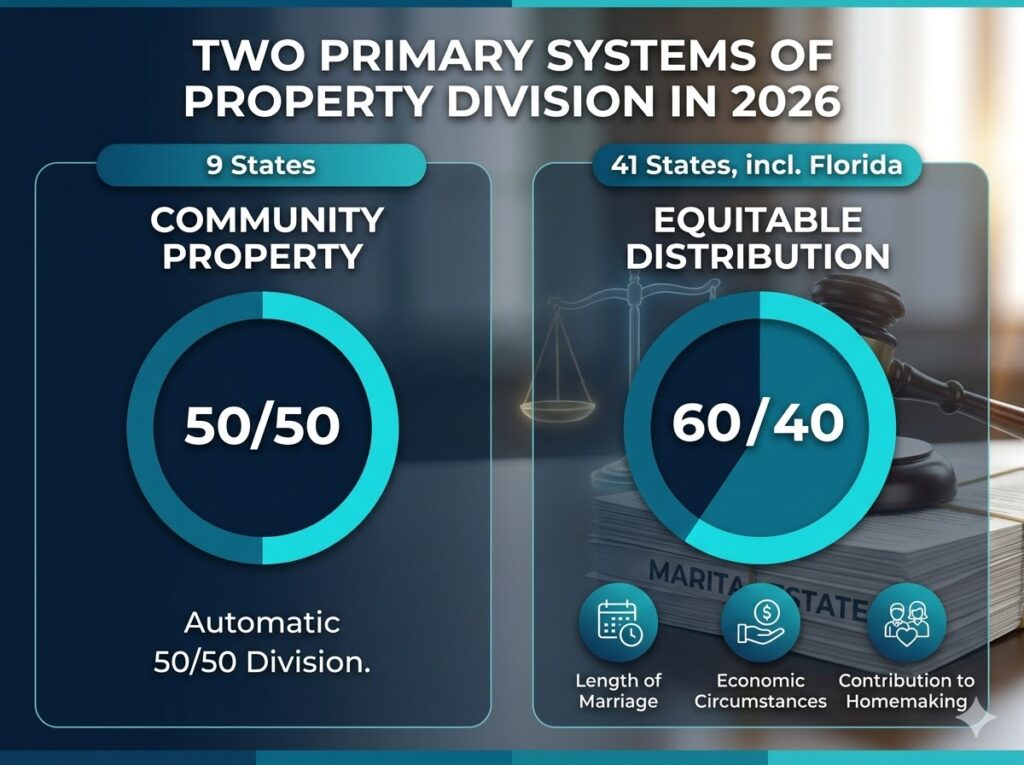
Unlike the strict division of property, where the split is always 50/50, the equitable distribution system permits the family court to look at the “big picture.” This does not necessarily mean a 50/50 split, but it could be, or it could be a 60/40 split, depending upon the court’s finding of equity so that both spouses are left in a good position at the time of the divorce.
How Do “Community Property” States Differ?
Nine states (Arizona, California, Idaho, Louisiana, Nevada, New Mexico, Texas, Washington, and Wisconsin) take the community property approach. These states view marriage as a joint undertaking where both are equal partners. Therefore, all property acquired during the marriage is considered to belong to the marital community.
Florida’s Opt-in Exception: Some states like Alaska and Florida now allow couples to “opt-in” to a community property system, usually through a special agreement or trust (like the Florida Community Property Trust Act).
2. Marital vs. Separate Property: Who Owns What?
The first step in any divorce case is the identification of the marital residence, bank account balances, and other holdings.
Marital Assets and Liabilities
These are assets and debts accumulated during the period of time the couple was married. This includes real-property, retirement plans, pension-plan contributions, and marital debt (credit cards, medical bills).
Separate Property (Non-Marital)
Separate assets are those that remain with the original owner, such as property ownership established premarital, or anything received via bequest, devise, or descent (inheritance).
3. What Happens When Property Gets Mixed Together?
It’s common for the lines between separate and marital property to blur. Florida courts have specific rules for handling these situations:
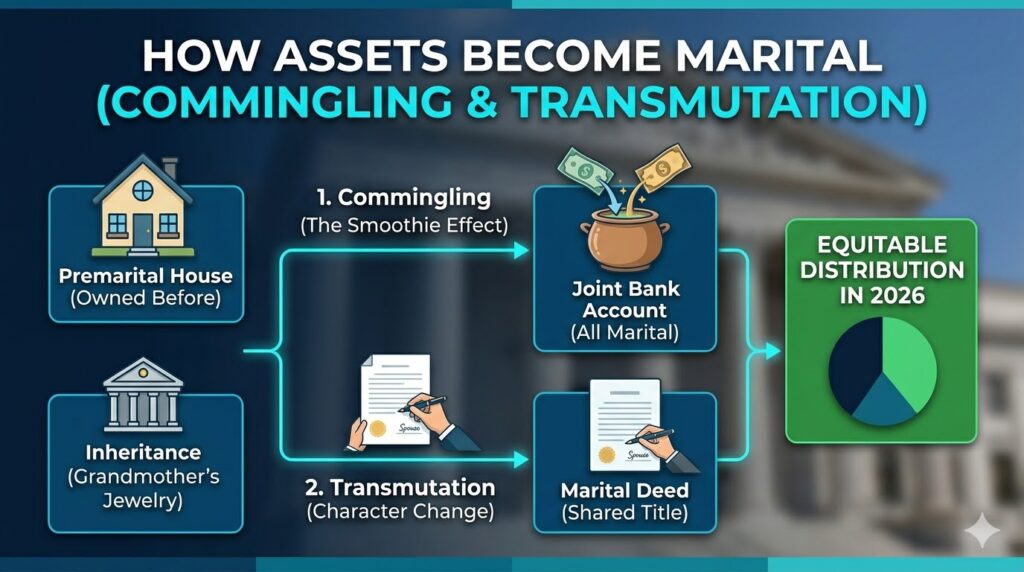
- Commingling: This is when separate and marital property are commingled. Let’s take a separate property banana and marital property strawberries. They are mixed together to make a smoothie. It is not possible to separate them. If funds are commingled to such a point that it is impossible to separate them, it is possible that all of them will be considered marital.
- Tracing: This is the process of proving that a portion of a commingled asset is still separate. It’s like trying to unscramble an egg—it requires meticulous documentation, such as bank statements, to prove separate funds were not intended to become marital.
- Transmutation: This is when spouses change the character of property. For example, a spouse might add their partner’s name to the deed of a house they owned before the marriage. This action can “transmute” the separate property into marital property.
4. Factors Influencing the Division of Assets
Under statutory guidelines, the court considers a wide range of factors to achieve a fair result:
- According to the statutory guidelines, a wide range of factors is taken into account by the court to ensure a fair result:
- Economic Contribution: The economic contribution of both husband and wife is taken into account, which also includes non-financial contributions such as homemaker and parenting.
- Parenting and Child Custody: The custodian is given the right to reside in the marital home for the benefit of the children.
5. What About the Reasons for the Divorce? (Economic Misconduct)
Florida is a “no-fault” divorce state, which means that the court doesn’t have to have a reason such as adultery in order to grant the divorce. However, the reason for the divorce can become very important if there was a monetary effect on the marital property.
Adultery and Misconduct
If the reason for the divorce was the other spouse having an affair or committing some other egregious act, the court will look at the economic impact that the act had on the marriage. For example:
Waste of Assets: If the funds were spent on hotel rooms, luxury gifts, or travel for the paramour, this is dissipation.
6. Support and Maintenance: Alimony and Child Support
Beyond just splitting items, the divorce decree includes financial support:
- Spousal Maintenance (Alimony): Alimony payments are based on the need of one spouse and the ability of the other party to pay.
- Child Support: Calculated to ensure the support child needs are met.
- Pendente-lite Relief: Temporary support granted while the divorce case is still ongoing.
7. Complex Assets: Pensions and Business Interests
Dividing a retirement-plan or annuity often requires a Domestic Relations Order to avoid tax penalties. For business owners, the distribution of property must account for the company’s future value and “goodwill” if it was accumulated during the marriage.
8. Avoiding Litigation: Negotiating a Settlement
Not every divorce proceeding needs to be contested. Many couples opt for divorce mediation with a certified mediator or an uncontested divorce. A prenuptial agreement is the best way to define property law terms before a conflict arises.
9. The Risks of Hiding Assets
Some try hiding assets to avoid equal division. In Florida, this is a serious form of contempt. If the court finds a spouse hid a bank-account, they can face heavy fines or lose their share of the property settlement.
Summary: Navigating Florida Property Law
So, is Florida a community property state? No. It is an Equitable Distribution state where family-law focuses on a fair disposition of the marital estate.
It should be noted that unlike the enumerated powers of the federal government, the authority for the regulation of marriage and divorce is vested in the individual states. This explains the vast differences between the rules for the distribution of property in Florida compared to other states in the nation.
Regardless of the property in question, real or personal property or retirement plans, the importance of understanding the divorce laws in the state-to-state context cannot be overstated. If you are in the process of obtaining a divorce, you should always consult with a qualified divorce lawyer or family law attorney!
Disclaimer
I am not an attorney. Estate planning and divorce matters in Florida are complex, especially regarding community property trusts. Consult with a qualified Florida attorney