
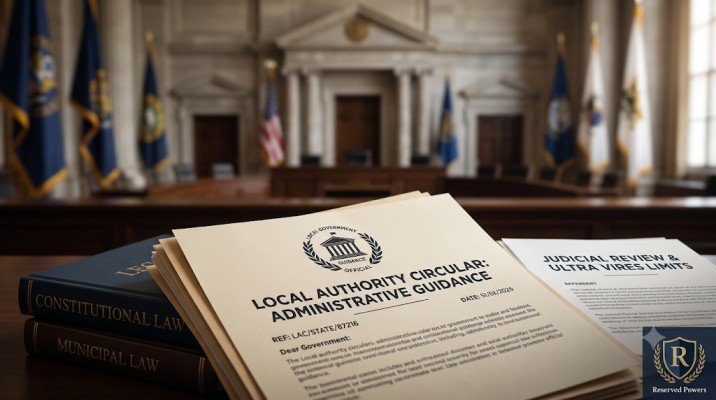
In my past years of studying constitutional law and administrative frameworks, then one question comes up repeatedly from policy researchers and attorneys: How much legal weight does a routine government circular actually hold?
When regional administrative bodies, municipal councils, or local governments receive formal operational guidance from central or state departments, it typically arrives in the form of a Local Authority Circular (LAC).
For legal scholars, municipal attorneys, and policy researchers navigating administrative law, understanding the exact legal nature of these circulars is critical. While they are indispensable tools for administrative efficiency, they often spark intense debates regarding local autonomy, administrative overreach, and the constitutional balance established under The Tenth Amendment.
Table of Contents
1. What is a Local Authority Circular?
A Local Authority Circular is a formal administrative document or policy directive issued by a central government ministry, state department, or federal agency to regional and municipal governance units.
Unlike primary legislation (statutes passed by a legislative body) or secondary legislation (formal rules enacted via statutory rulemaking processes), circulars occupy a unique space in administrative law. They function primarily as administrative guidance designed to bridge the gap between high-level legislative intent and ground-level municipal execution.
Core Objectives of a Circular:
- Statutory Clarification: Interpreting ambiguous clauses within existing legislation for local implementers.
- Operational Directives: Outlining standard operating procedures for public health responses, urban planning, or welfare distribution.
- Conditional Funding Terms: Stipulating administrative compliance requirements tied to state or federal grants.
- Emergency Memos: Delivering rapid policy shifts during public safety or economic crises.
2. Do Local Authority Circulars Carry Binding Legal Force?
A central question in municipal law is whether local authorities are legally mandated to comply with every instruction written inside a circular. The answer depends strictly on its legal categorization:
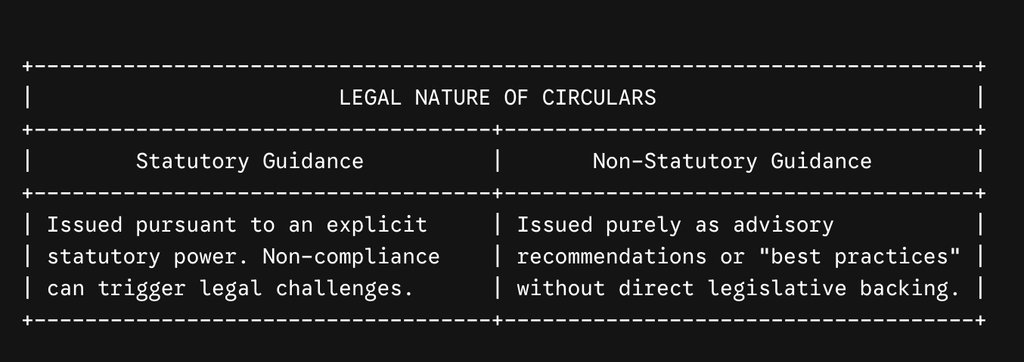
A. Statutory Guidance (Mandatory Effect)
If the parent statute explicitly mandates that a local authority must “have regard to” or “act in accordance with” guidance issued by a specific minister or department, the circular carries legal weight.
While local councils retain minor discretionary wiggle-room in execution, ignoring a statutory circular without a robust, legally defensible rationale exposes the municipality to judicial review and administrative nullification.
B. Non-Statutory Guidance (Advisory Effect)
If a circular is issued without a direct statutory hook—acting merely as a departmental recommendation or policy preference—it is non-binding. Local authorities retain the legal right to depart from non-statutory guidelines, provided their alternative approach remains within their broader statutory framework, including areas governed by Concurrent Powers.
A Quick Real-World Analogy:
Think of non-statutory circulars like advisory speed limit signs on a highway curve. They represent strongly recommended best practices designed by experts for safety. However, unless backed by an explicit statutory law setting a strict speed limit, failing to follow the advisory speed isn’t automatically an illegal act—unless your driving violates broader laws of negligence.
In the same way, local councils can depart from non-advisory circulars if they have a rational, well-documented reason that aligns with parent legislation.
3. The Constitutional Intersection: Federalism and Local Autonomy
From the lens of constitutional law and federalism, local authority circulars represent a delicate power balance.
In decentralized governance frameworks, powers not explicitly delegated to the central government remain with the states—a core principle rooted in The Tenth Amendment. State governments, in turn, delegate specific operational duties to local municipalities.
When central bodies issue sweeping circulars, it triggers key constitutional tensions:
- Uniformity vs. Local Discretion: Central administrators use circulars to ensure standardized service delivery nationwide, but this can stifle local innovation and responsiveness to regional needs.
- The Risk of Administrative Creep: If higher levels of government use non-binding circulars to subtly coerce local councils into adopting policies that bypass formal legislative debate, it infringes upon established local governance boundaries.
4. Real-World Case Study: Judicial Review and Ultra Vires Limits
To see how courts treat administrative circulars in practice, we look at the legal doctrine of ultra vires (acting beyond one’s legal power).
The Dispute Scenario
A state department issues a Local Authority Circular threatening to withhold vital infrastructure grants unless local councils enforce a brand-new, aggressive zoning mandate that was never authorized under the department’s statutory scope or Expressed Powers.
The Judicial Challenge
Several municipal authorities file for judicial review, arguing that the department is unlawfully using an informal administrative circular to rewrite statutory funding rules and penalize non-compliance.
The Court’s Ruling & Legal Principle
Courts consistently rule that guidance cannot amend or expand a statute.
- Subordinate Status: While an agency can interpret existing law, it cannot invent new substantive duties, taxes, or penalties via a circular.
- Legal Boundary: If an agency wants mandatory compliance on a novel policy, it must pursue formal statutory rulemaking or legislative amendment rather than relying on informal administrative directives.
5. Best Practices for Legal Compliance and Review
For attorneys, compliance officers, and local government officials reviewing an incoming circular, a rigorous three-step audit should always be performed:
- Trace the Parent Statute: Identify the exact legislative provision cited as the legal authority for the circular. Does that provision grant rule-making or directive power?
- Analyze Mandatory Language: Differentiate between binding statutory language (“shall”, “must comply”) and advisory language (“should consider”, “recommended practices”).
- Assess Proportionality: Determine whether the circular’s instructions respect local discretionary powers or cross the line into unlawful administrative coercion.
Q1: What is a local authority circular?
A local authority circular is an official administrative document or policy guidance issued by a central government department, state agency, or federal body to municipal councils and regional governance units. It provides operational instructions, statutory clarifications, or financial grant conditions.
Are local authority circulars legally binding?
It depends on their legal foundation. Statutory guidance backed by explicit legislative power carries legal weight, whereas non-statutory advisory guidance is non-binding and allows local authorities reasonable discretion to depart from it.
Can a government department change or expand a law using a circular?
No. Under administrative law principles, guidance and circulars cannot rewrite, amend, or expand a parent statute. New binding legal duties or penalties require formal statutory rulemaking or legislative amendments.
How do local authority circulars affect federalism and local autonomy?
They create a delicate balance between central policy uniformity and local governance, though overly restrictive circulars can sometimes spark debates over administrative overreach and local autonomy